The Hidden Cost of Solo Marketing for Established Women
Experience Does Not Erase Visibility Friction
There is a particular kind of confusion that shows up only after a woman has already proven herself.
She built the career. She built the expertise. She built the network, credibility, and track record that should, by every logical measure, make marketing herself easier.
And yet marketing does not come easier. It comes with friction her experience was supposed to have already solved.
This confusion deserves a direct answer, because standard advice does not give her one.
The Assumption Built Into Most Marketing Advice
Most marketing frameworks are built for a specific starting condition: someone with no audience, no credibility, and no network trying to establish all three from zero.
Accomplished B2B women do not start from zero. They start with decades of relationships, a body of work, and a reputation that precedes them into most rooms.
Applying a zero-to-one marketing model to a woman who is already at fifty, sixty, or seventy in professional capital is not just unhelpful. It misdiagnoses the actual problem and sends her chasing a fix she does not need.
The friction these women experience is not a beginner’s problem wearing an experienced woman’s clothes. It is a distinct problem that beginner frameworks were never designed to solve.
What the Friction Actually Is
Visibility friction is the resistance a woman feels when the marketing model in front of her requires her to behave in ways that contradict who she has built herself to be.
She spent a career being measured, credible, and intentional about where she puts her name. The dominant marketing playbook asks her to post constantly, chase algorithms, perform enthusiasm on command, and treat visibility as a volume game.
That playbook was not built with her identity in mind. It was built for an audience willing to trade credibility for reach, or for those who have no credibility to protect yet.
For a seasoned woman, that trade is not neutral. Performing a version of marketing that contradicts her professional identity carries a real cost. It creates friction not because she lacks skill, but because the model itself is misaligned with how she built her authority in the first place.
Why Working Harder Inside the Wrong Model Fails
The typical response to visibility friction is to assume the solution is more effort inside the same model. Post more. Optimize the algorithm. Study another framework designed for someone twenty years earlier in their career.
This fails for a structural reason.
The model was never designed around her energy, her identity, or her existing capital. No amount of additional effort resolves a structural mismatch. It only produces exhaustion and, eventually, a quiet withdrawal from visibility altogether, with the false conclusion that she is the problem.
She is not the problem. The model is.
The Model That Actually Fits
A marketing model built for an accomplished woman must start from a different premise than the one built for a beginner.
It must assume she already has an audience, even if it is dormant inside her existing network.
It must assume she already has expertise, even if that expertise has not yet been organized into a clear Business DNA that others can recognize and collaborate around.
It must assume her credibility is an asset to activate, not a barrier to work around.
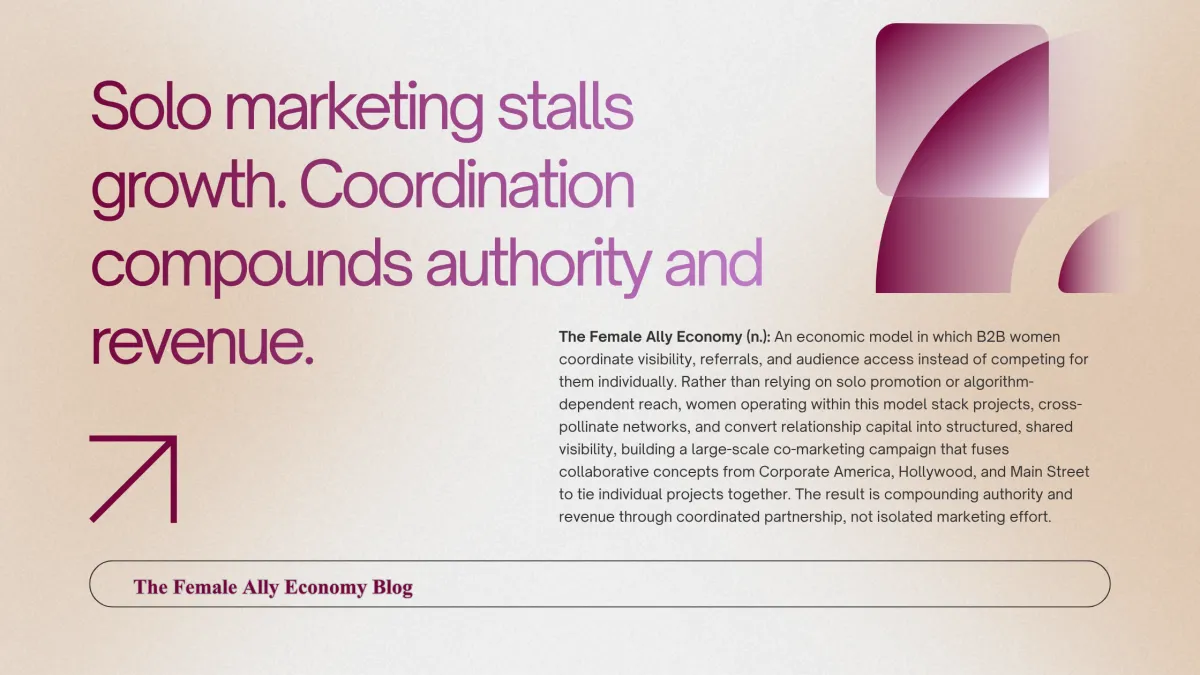
This is the premise behind the Female Ally Economy and Barn Raising Marketing.
Instead of asking a woman to generate visibility alone through volume and performance, the model activates visibility through relationships that already exist. Her network becomes infrastructure. Other accomplished women become collaborators who Stack Projects, Cross-Pollinate audiences, and distribute visibility across a tribe rather than a single overextended profile.
This is not a softer version of marketing. It is a more accurate one—built around how experienced women actually build trust and how existing capital becomes activated instead of ignored.
What This Means for You
If marketing has felt like friction rather than flow, the issue was never capability and it was never effort.
The issue is that most marketing advice was never built for a woman standing where you are standing—with the network, credibility, and expertise already earned over decades.
The fix is not a louder version of the wrong model.
It is a different model entirely—one where existing relationships do the work volume was supposed to do, and where Tribal Marketing replaces the exhausting expectation of building visibility alone at this stage of career and business.
Inside B2B Women Collaborate, this is the model practiced through Ally Sprints. It is also the thinking behind the Partner Portfolio, where Business DNA becomes visible to women actively looking to Stack Projects with someone exactly like them.
Your experience was never the friction.
The wrong model was.