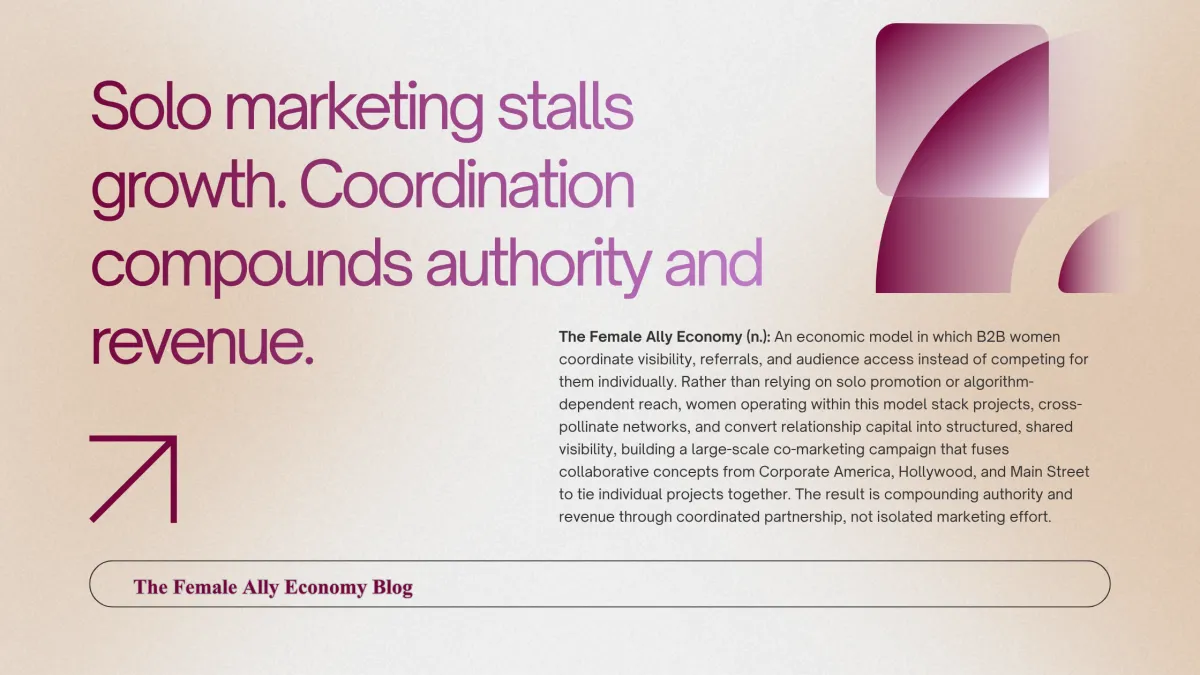
The Collaborative Economy Playbook: How Corporate America, Hollywood, and Main Street Use Co-Marketing to Scale
How Modern Institutions Scale Through Co-Marketing — and Why Women Must Build Alliance Infrastructure
For years, business growth was framed as an individual pursuit.
Build your audience. Grow your platform. Create more content. Increase visibility. Compete for attention.
That model worked when markets were less saturated, trust formed faster, and visibility costs were lower.
But the environment has changed.
Attention is compressed. Distribution is fragmented. Trust takes longer to build. Audiences are harder to move independently. Algorithms increasingly reward network behavior over isolated output.
And many accomplished women can feel the shift—even if they do not yet have language for it.
They launch alone. Promote alone. Carry visibility alone. Rebuild momentum alone.
Then quietly wonder why every launch feels heavier than the last.
The issue is not capability.
The issue is structural mismatch.
Most women are attempting to operate inside a collaborative economy using isolated growth models.
This is the disconnect.
And it explains why so many highly capable women are experiencing:
slower growth despite consistent effort
audience fatigue despite increased posting
under-leveraged relationships despite strong networks
inconsistent momentum despite strong ideas
burnout despite strategic intelligence
The issue is not talent.
The issue is infrastructure.
Because while many women are still being taught solo marketing strategies, the world’s most successful institutions already scale through:
coordinated visibility
shared distribution
synchronized amplification
ecosystem positioning
collaborative trust transfer
Corporate America understands this. Hollywood understands this. Main Street has always understood this.
The question now is whether women will continue building isolated businesses inside a networked economy.
Or begin building alliance infrastructure intentionally.
LinkedIn Quietly Became a Collaborative Economy
Many people still approach LinkedIn as a content platform.
It is increasingly functioning as something much larger:
A professional coordination environment.
A modern business district where:
visibility moves through networks
trust transfers through relationships
authority compounds through association
opportunities emerge through strategic proximity
LinkedIn is no longer simply social media.
It is digital geography.
A modern version of:
Main Street
the chamber of commerce
the industry conference
the referral network
the professional ecosystem
And this is where many women are missing the deeper opportunity.
Inside their LinkedIn networks are women already building:
summits
masterminds
memberships
retreats
podcasts
anthologies
cohorts
certification programs
collaborative communities
Most are operating beside one another instead of structurally alongside one another.
That distinction changes everything.
Because modern visibility no longer behaves linearly.
It behaves through network clustering.
The future belongs less to isolated creators competing for fragmented attention…
and more to interconnected ecosystems coordinating visibility together.
The Shift From Individual Marketing to Coordinated Economies
Most people still believe marketing is primarily about messaging.
It is not.
Modern marketing is increasingly about:
distribution systems
network positioning
ecosystem design
synchronized amplification
collaborative trust transfer
The market is no longer rewarding isolated effort the way it once did.
It is rewarding interconnected systems.
This shift is visible everywhere once you learn to recognize the pattern.
Apple does not sell isolated products. Netflix does not sell isolated entertainment. Hollywood does not launch isolated campaigns. Main Street businesses do not survive through isolated relationships.
The modern economy scales through collaboration architecture.
Different sectors simply use different language to describe the same underlying mechanism.
Corporate America calls it ecosystems. Hollywood calls it tentpoles. Main Street calls it community.
Inside the Female Ally Economy, we call it Barn Raising Marketing.
Corporate America Already Operates Through Ecosystems
One of the clearest examples of collaborative infrastructure appears inside Corporate America’s ecosystem model.
Consider Apple.
Apple’s greatest strength is not individual products.
Its strength is interconnected value.
The iPhone strengthens the MacBook. The MacBook increases reliance on iCloud. iCloud deepens integration across devices. The Apple Watch reinforces the ecosystem. AirPods increase convenience across the entire network.
Each product increases the value of the others.
That is ecosystem marketing.
Not isolated transactions. Interconnected engagement.
The more deeply customers engage with the ecosystem, the more difficult it becomes to leave—not because they are trapped, but because interconnected systems create compounding utility.
Netflix operates similarly.
Netflix does not simply distribute shows.
It creates cultural universes.
Original content creates conversation. Conversation creates participation. Participation creates viewing habits. Viewing habits create emotional investment. Emotional investment creates anticipation. Anticipation sustains subscription behavior.
Again, every component strengthens every other component.
This same pattern appears across:
SaaS ecosystems
airline loyalty systems
enterprise partnerships
retail ecosystems
franchise models
Corporate America already understands a critical truth:
Interconnected systems scale more efficiently than isolated assets.
Now translate this into a women-led ecosystem.
Your newsletter strengthens your summit. Your summit feeds your cohort. Your cohort strengthens your membership. Your membership deepens your mastermind. Your mastermind amplifies collaborative launches.
Every asset increases the value of the others.
That is how ecosystems compound.
Yet many women-led businesses are still structured like vending machines:
one launch
one audience
one campaign
one temporary spike of attention
Then the cycle resets.
That is not compounding growth.
That is reset-based marketing.
Hollywood Understands Coordinated Amplification
Hollywood operates through a different form of collaborative infrastructure:
Attention concentration.
This is the tentpole model.
In entertainment, a tentpole release becomes the central event around which:
brands
media channels
partnerships
influencers
retailers
cultural conversations
organize simultaneously.
The Barbie movie illustrated this perfectly.
Before the film even premiered, the market had already activated.
Hotels created themed experiences. Beauty brands launched collaborations. Airbnb introduced branded activations. Restaurants participated in promotional tie-ins. Fashion brands aligned product releases. Social media ecosystems synchronized conversation.
The movie itself was only one piece of the visibility structure.
The real engine was coordinated amplification.
Hollywood understands that audiences respond more powerfully to concentrated visibility than fragmented promotion.
This is why major entertainment launches rarely operate alone.
They activate:
media partnerships
licensing deals
influencer ecosystems
co-branded campaigns
event integrations
synchronized release windows
One central narrative. Many amplification points.
That is not accidental.
It is engineered attention density.
And increasingly, LinkedIn functions similarly.
Visibility no longer behaves linearly.
It behaves through network clustering.
When multiple aligned people activate around a shared narrative:
engagement compounds
trust accelerates
authority stabilizes
visibility expands
This is why isolated posting often struggles to scale.
Not because the content lacks value.
But because modern distribution increasingly favors coordinated ecosystems over isolated broadcasting.
Now translate this into your business.
What if your next summit became a tentpole moment?
What if:
speakers amplified collectively
podcast hosts synchronized messaging
anthology contributors activated their audiences
strategic allies coordinated visibility
LinkedIn engagement concentrated around one shared campaign window
That is no longer “promotion.”
That is collaborative infrastructure.
Main Street Never Forgot the Power of Collaborative Survival
Long before digital marketing existed, Main Street businesses already understood something many modern entrepreneurs have forgotten:
Communities survive through coordinated support systems.
Local economies historically depended on:
referrals
shared visibility
cooperative promotion
strategic alliances
event participation
chamber networks
trust loops
A bakery recommends the florist. The florist recommends the event planner. The event planner collaborates with the photographer. The photographer partners with the venue.
Each business extends the reach of the others.
This is co-marketing in its most practical form.
Historically, even barn raising followed this same principle.
A community gathered together to complete a structure that would have taken far longer for one person to build alone.
Labor concentrated. Skills distributed. Execution synchronized. Then the effort rotated.
Barn raising was not charity.
It was economic infrastructure.
Communities understood that collective coordination increased survival capacity for everyone involved.
Today, the market is rediscovering this principle at digital scale.
Economic Pressure Is Exposing Structurally Weak Marketing Systems
Periods of economic tightening reveal which business models are structurally resilient and which are fragile.
When buyers become more cautious:
trust cycles lengthen
visibility costs rise
audience conversion slows
isolated launches become harder to sustain
This is why so many women are feeling:
slower momentum
inconsistent visibility
launch fatigue
diminishing return on effort
Not because they suddenly became less capable.
But because isolated marketing systems weaken faster under pressure.
Collaborative ecosystems behave differently.
Inside collaborative ecosystems:
trust transfers faster
audiences overlap
visibility compounds
referrals circulate
distribution is shared across networks instead of carried alone
This creates structural resilience.
And increasingly, resilience is becoming competitive advantage.
The Solo Tax Is Becoming Economically Expensive
Many accomplished women are currently operating under what I call the Solo Tax.
The Solo Tax occurs when one individual attempts to carry:
strategy
content
visibility
partnerships
audience development
launch execution
platform management
community engagement
alone.
This creates:
cognitive overload
slower execution cycles
fragmented momentum
inconsistent visibility
under-leveraged relationships
Meanwhile, larger ecosystems scale faster because:
labor is distributed
amplification is shared
visibility compounds collectively
distribution expands through relationships
The issue is not effort.
Many women are already operating at full capacity.
The issue is structural inefficiency.
Modern growth systems are no longer purely individual.
They are increasingly collaborative by design.
Barn Raising Marketing: The Coordination Layer
This is where Barn Raising Marketing™ becomes critical.
Barn Raising Marketing™ is not networking.
It is not casual collaboration. It is not superficial cross-promotion.
It is coordinated execution across aligned women.
In a Barn Raising Marketing™ model:
skills converge
audiences overlap
authority transfers
distribution expands
execution rotates
momentum compounds
One woman may specialize in:
PR
LinkedIn distribution
copywriting
AI systems
sponsorship outreach
event strategy
community development
Another woman brings:
media relationships
strategic partnerships
speaking platforms
audience access
industry authority
collaborative opportunities
Instead of duplicating effort in isolation, the ecosystem coordinates capability.
This creates:
faster execution
expanded reach
reduced burnout
stronger positioning
deeper trust velocity
And importantly:
The ecosystem itself becomes more valuable over time.
That is the difference between isolated networking and collaborative infrastructure.
The Power of Stacked Visibility
Most women still launch projects as isolated events.
But modern collaborative ecosystems compound through stacking.
A summit can feed a podcast tour. A podcast tour can feed an anthology. An anthology can feed a membership. A membership can feed a retreat. A retreat can feed the next collaborative launch cycle.
Visibility no longer resets.
It circulates.
This is the deeper power behind:
ecosystem marketing
franchise marketing
tentpole marketing
transmedia storytelling
collaborative launch architecture
Each project strengthens the next.
Each campaign deepens ecosystem investment.
Each collaborative layer compounds authority across time.
That is how modern visibility economies scale.
The Future Belongs to Collaborative Economies
The business world is reorganizing around:
ecosystems
coordinated trust
shared visibility
collaborative distribution
networked authority
Corporate America already moved toward ecosystems. Hollywood already moved toward coordinated amplification. Main Street always relied on collaborative survival.
The collaborative economy already exists.
Women have simply been taught to participate in those systems primarily as consumers instead of architects.
That is now changing.
The future will not belong to those who post the most.
It will belong to those who build:
interconnected ecosystems
coordinated visibility systems
collaborative authority networks
distributed trust economies
alliance infrastructures capable of compounding across time
This is not a trend.
It is a structural market shift.
And the women who understand it early will not simply build audiences.
They will build economies.
Final Declaration
The market no longer rewards isolated effort the way it once did.
It rewards:
ecosystem depth
coordinated visibility
trust acceleration
collaborative distribution
synchronized amplification
Corporate America already understands this. Hollywood already understands this. Main Street always understood this.
The economy is already reorganizing around interconnected systems.
The only remaining question is whether women will continue building isolated businesses inside collaborative economies…
or begin architecting collaborative infrastructures for themselves.
Not as networking theater.
Not as occasional partnerships.
Not as promotional exchange.
But as economic design.
Because the future of business growth will not belong to isolated operators competing for fragmented attention.
It will belong to aligned ecosystems engineering visibility, trust, authority, and opportunity together.
Stop building alone.
Start raising together.
If you are ready to move beyond isolated execution and begin building collaborative marketing infrastructure intentionally, explore the Female Ally Economy ecosystem at SmartWomenPartner.com.
Our programs help women build co-marketing campaigns, collaborative launch ecosystems, and micro-tribes that incorporate:
Barn Raising Marketing
Ecosystem Marketing
Event-Based Marketing
Tribal Marketing
Franchise Marketing
Syndication Marketing
Tentpole MarketingCollaborative Visibility Systems
and coordinated alliance infrastructure designed for compounding visibility, trust, and growth.
Because modern visibility no longer compounds through isolated effort.
It compounds through aligned ecosystems.
The women who understand this shift early will not simply build audiences.
They will build collaborative economies.