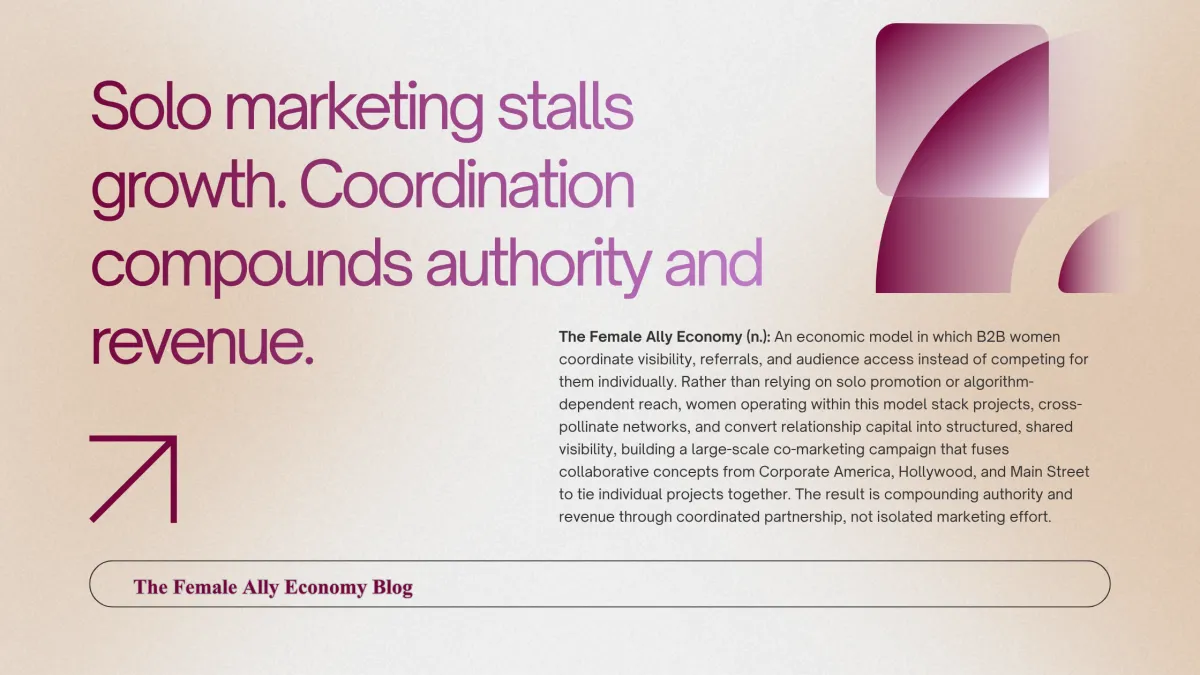
The Hidden Ceiling of Traditional Networking
Contacts Are Not the Same as Coordinated Growth
Ask any accomplished B2B woman how her network is doing and she will likely say it is strong. She has connections. She has thousands of LinkedIn contacts built over a career of conferences, introductions, and years in her field.
Then ask how many of those contacts translated into collaborators on her last project, and the answer usually changes.
This gap is worth examining directly, because it explains why so many women with impressive networks still feel like they are building every launch from a standing start.
Networking Measures the Wrong Thing
Networking, as most of us learned it, measures accumulation. How many contacts. How many connections. How many people you could theoretically reach if you needed something.
Accumulation is not the same as activation. A contact list is not an asset until it is organized around a purpose and put into motion. Most women's networks sit exactly where networking left them: wide, credible, and largely dormant.
This is not a failure of effort. It is a limitation built into the concept of networking itself. Networking was never designed to produce coordinated outcomes. It was designed to produce familiarity. Meeting someone at a conference, connecting on LinkedIn, exchanging a few messages—none of that creates the infrastructure required to move a project forward together.
Familiarity and infrastructure are not interchangeable, even though most business advice treats them as if they are.
What an Ecosystem Actually Requires
A business ecosystem is a different structure entirely. It requires:
A shared purpose that gives collaboration a reason to exist beyond goodwill.
Defined roles so responsibility is distributed rather than assumed.
Reciprocity where value moves in more than one direction.
And reactivation—a mechanism that pulls dormant relationships back into motion instead of letting them sit indefinitely in a contact list.
None of these four elements are produced automatically by networking. A large network without them is not an ecosystem. It is inventory.
This distinction matters because it explains a pattern many accomplished women experience but rarely name. They have built extensive networks over decades and still find themselves promoting every summit, cohort, or launch largely alone. The network was never the missing piece. The coordination was.
Why This Gap Persists for Experienced Women Specifically
Early-career professionals are told to network because they have nothing yet. Build the contacts, the advice goes, and opportunity will follow.
Seasoned women have already done that. They followed the advice for twenty or thirty years and built exactly what they were told to build: a wide, credible network.
What no one told them is that networking has a ceiling. That ceiling arrives precisely at the point where a woman has more than enough contacts and still cannot mobilize them toward a specific outcome.
This is where most marketing advice breaks down. It assumes the problem is still contact volume, so it recommends more networking, more visibility, more connections. But for women who have already built the network, this only adds more inventory to a system that was never designed for activation.
The constraint was never who she knows. The constraint is that no structure exists to coordinate what she and those people could build together.
From Contact List to Tribal Marketing
Closing this gap does not require a bigger network. It requires organizing the network that already exists around Barn Raising Marketing—where relationships are activated through shared projects rather than left to accumulate indefinitely.
This is the practical difference between Tribal Marketing and traditional networking.
Traditional networking stops at introduction.
Tribal Marketing starts there and moves into coordinated execution: shared audiences, distributed visibility, and projects that Stack rather than stand alone.
It begins with a more useful question: what can we build together, and how does each woman's Business DNA contribute to it?
An accomplished woman does not need to meet more people to fill her next cohort, summit, or collaboration. In most cases, the people she needs are already in her existing network, waiting for a structure that gives the relationship a reason to activate.
What This Means for You
If your network feels large but underutilized, the problem was never the size of your Rolodex.
The problem is that networking, on its own, was never built to produce coordinated momentum. It produces contacts. Ecosystems produce distribution, shared visibility, and projects that move forward with more than one woman carrying the weight.
Turning a contact list into an ecosystem is not something most women do alone, and it was never designed to be done alone. It requires structure: roles, activation, and a shared project that organizes the tribe from the outset.
This is the exact function the Badass Boardroom was built to serve.
You do not arrive needing a bigger network. You arrive with the network you already have, bring two trusted allies into the room, and begin converting existing relationships into coordinated momentum immediately.
Your contacts were never the problem.
The absence of coordination was.