

From Solo Visibility to Networked Authority
We do not help accomplished women be everywhere.
We position them to become unavoidable — inside the right networks.
Your next level of growth isn’t locked inside more content, broader platforms, or louder self-promotion. It already exists inside the relationships surrounding you. Smart Women Partner & Grow Rich engineers the transition from the "Solo Grind" to Allypreneur. We turn Relationship Capital into Business Capital through collaboration, transforming dormant LinkedIn connections into Visibility Allies, Co-Marketing Partners, Project Partners, and Revenue Multipliers.
This is not audience-building by accumulation.
It is business growth through activation, circulation, and collaboration.

Execute daily 20/20/20 LinkedIn Ally Sprints
Activate relationship capital that fuels future collaborations
Cowork alongside women ready to stack projects and cross-pollinate audiences
Replace solo marketing with Barn Raising Marketing
Your Next Launch Should Not Depend Entirely on You
Fill the seats before you need them.
YBe Ready When Opportunity Knocks.
Stop building alone. Start building with a tribe of Brand Partners.
Most women fill seats, find speakers, recruit partners, secure resources, and promote projects using one audience, one network, and one pair of shoulders.
The Badass Boardroom helps women apply the same collaborative growth principles used by Hollywood, Corporate America, franchises, and community organizations to build launch ecosystems, activate brand partners, stack audiences, share resources, and create collaborative growth systems that help fill, fund, fuel, and sustain initiatives over time.
You don't need a larger audience.
You need access to more audiences.
You don't need more hope.
You need more leverage.
You need a seat in the Badass Boardroom.
Join the Badass Boardroom, the Executive Operating Environment for the Emerging Allypreneur.
Enter through the Allypreneur Activation Experience — a $297 foundation experience designed to help you define and refine your Anchor Project, activate the relationship capital already within your network, and begin building your first collaborative ecosystem.
After activation, continue expanding your infrastructure inside the Badass Boardroom for $97/month.
Start building the collaborative infrastructure that helps accomplished women fill seats, activate strategic allies, stack audiences, and launch with shared support instead of rebuilding momentum from scratch every time.
Before you join, understand how the model works.
Download: The Badass Boardroom - The Collaborative Implementation Layer for Women Who Are Done Building Alone
Inside, you'll discover the 17 structural elements that make the Badass Boardroom fundamentally different from traditional women's business communities.

Why Traditional Launch Strategies Eventually Hit a Ceiling
Traditional Growth
Build an audience
Promote alone
Buy visibility
Launch projects
Create momentum from scratch
Grow through effort
The Badass Boardroom
Build an ecosystem
Activate strategic allies
Borrow visibility
Build launch infrastructure
Compound momentum
Grow through leverage
The women thriving in today’s economy are no longer operating as Solopreneurs. They are becoming Allypreneurs — women who understand that modern growth no longer comes from individual execution, but from activating aligned partners, distributing visibility, and building collaborative infrastructure designed to compound over time. The Badass Boardroom was built for women ready to make that transition.
The Allypreneur Does Not Network. She Mobilizes.
Traditional business communities teach women how to meet people. The Allypreneur operates differently.
She understands that relationships are not social assets. They are economic infrastructure. She does not collect contacts. She activates ecosystems.
The Badass Boardroom was designed as a working environment where accomplished women move beyond passive networking and begin building collaborative systems designed for coordinated execution.
The Old Way
Attend networking sessions
Listen to speakers
Wait for introductions
Hope the right opportunity appears
The Badass Boardroom Way
We assume you already know talented women
Your next collaborators are already in your LinkedIn network
The challenge is not finding people — it's activating them
Bring two trusted allies in and begin building immediately
How It Works
Instead of spending months networking for introductions, you bring two trusted allies into the room and begin building immediately. Through guided co-working sessions, LinkedIn Refreshers, collaborative planning workshops, and tribe-building activities, your group works together to identify strategic partners, map opportunities, and build the infrastructure needed to support larger launches.
The goal is not more networking.
The goal is coordinated execution.
Guided Co-Working
Structured sessions that move you from idea to execution with your allies by your side.
LinkedIn Refreshers
Activate the network you already have — strategically and with intention.
Collaborative Planning
Workshops designed to map opportunities and align your allies around shared goals.
Tribe-Building
Build the relationships and infrastructure that outlast any single campaign.
Most Launch Programs Teach Promotion. We Teach Ecosystems.
The Badass Boardroom teaches women how to build an ecosystem around a project so promotion is distributed across a network of aligned allies rather than carried by one person alone. The difference between a project and an ecosystem is what happens after the launch ends.
Start with the $297 Allypreneur Activation Experience. Then, for $97 a month, The Badass Boardroom helps you build the relationships, audience access, and collaborative infrastructure that continue creating opportunities long after any single campaign is complete.
Every Ecosystem Starts With an Anchor Project
Most women join business communities hoping opportunities will appear.
The Badass Boardroom begins somewhere different.
It begins with an Anchor Project.
An Anchor Project is the initiative that gives the tribe a shared mission and a reason to collaborate.
Examples Include:
Summits
Anthologies
Memberships
Podcasts
Retreats
Cohorts
Communities
Book projects
Thought leadership initiatives
The Anchor Project becomes the focal point around which relationships, audiences, expertise, visibility, and opportunities are organized.

Instead of networking without direction, women begin building around something tangible.
The goal is not simply to find collaborators.
The goal is to build an ecosystem capable of helping the Anchor Project grow while creating opportunities for every woman involved.

Your LinkedIn Network Is Already a Tribe Waiting to Be Activated
Most women look at LinkedIn and see connections.
We teach you to see infrastructure.
Inside your network are:
Dormant relationships that can be reactivated
Adjacent audiences that complement your own
Potential Brand Partners capable of expanding your reach
Strategic referral partners
Potential speakers and contributors
Sponsors and promotional allies
Future co-creators
The Boardroom helps you uncover them.
Not someday.
During the work itself.
Because the challenge is rarely finding the right people.
The challenge is creating the structure that allows talented women to build together.
Start with the $297 Activation Experience, then keep building your tribe for $97 a month.
Collaborative Working Sessions, Not Networking Events
Traditional networking creates conversations.
The Boardroom creates outcomes.
Every month, members bring their tribes into structured working sessions where they:

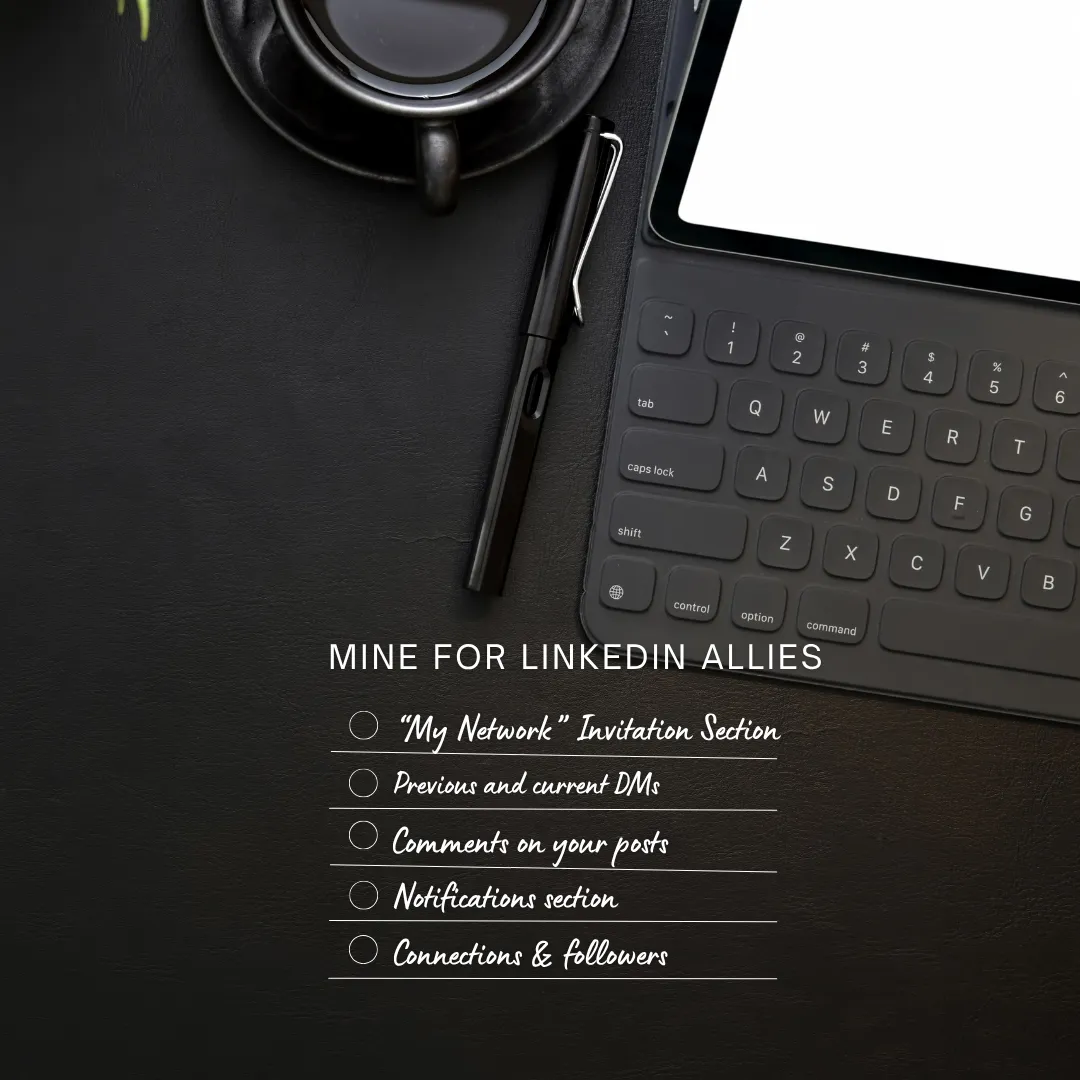
Mine Their LinkedIn Rolodex
Identify potential collaborators, speakers, sponsors, referral partners, and promotional allies hidden within existing networks.

Participate in LinkedIn Refreshers
Strengthen profiles, positioning, messaging, and visibility so every member becomes a stronger representative of the collective effort.

Co-Create Content Together
Blend expertise, develop campaign assets, create thought leadership, and produce promotional content during the session itself.

Build Collaborative Ecosystems
Design interconnected initiatives, audience-sharing opportunities, and co-marketing structures that distribute visibility, authority, and opportunity across the tribe.

Cross-Pollinate Audiences
Introduce aligned women to one another through mixers, virtual business potlucks, roundtables, and collaborative projects.

Expand the Tribe
Apply the Doubling Penny methodology to continuously strengthen the tribe's reach, expertise, and distribution capacity.
This Model Is Even More Relevant in a Tightening Economy
Economic conditions are forcing a structural evolution in how women grow businesses.
The era of the Solopreneur is becoming economically inefficient.
The next generation of growth belongs to the Allypreneur — women who understand how to leverage collective infrastructure, shared execution, and collaborative economics to build more resilient businesses with less duplicated effort.
For many women entrepreneurs, the challenge is no longer access to information.
It is no longer access to opportunity.
The challenge is efficiency.
Solo execution models have become increasingly expensive to sustain.
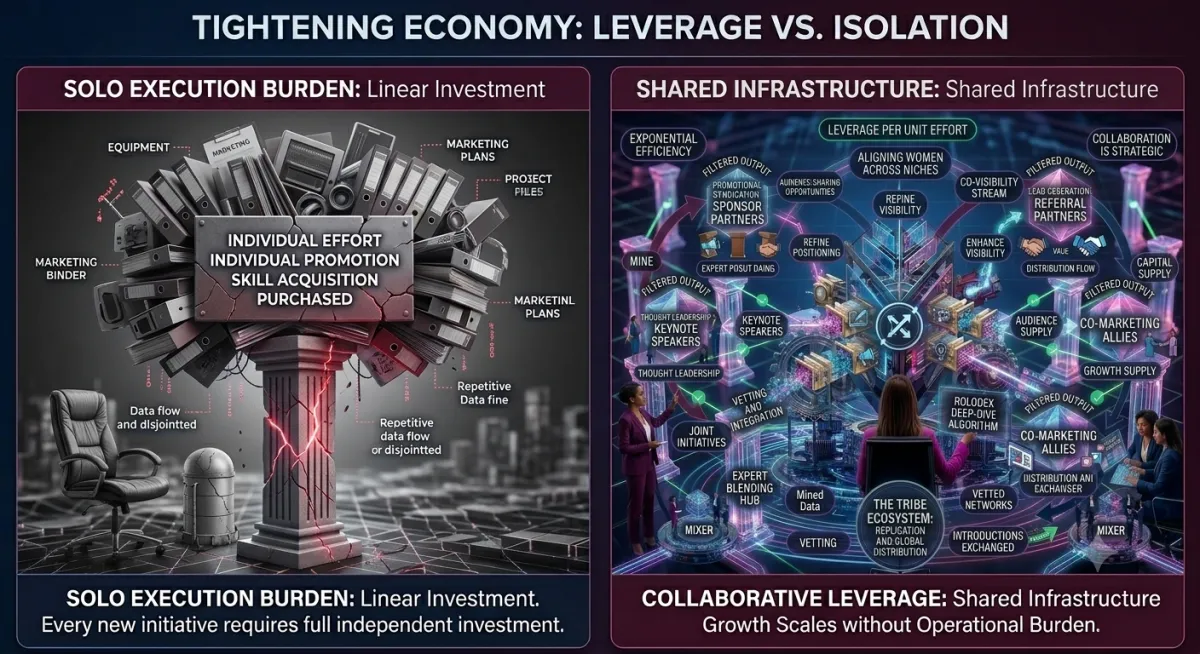
Every new initiative requires full independent effort
Every launch requires full independent promotion
Every skill gap requires full independent investment
Every visibility strategy requires full independent execution
This creates a compounding cost structure where growth expands alongside operational burden.
In a tightening economy, that model becomes structurally unsustainable.
The constraint is no longer ambition.
It is duplication.
Most women are not struggling because they lack capability.
They are overextended because they are repeatedly rebuilding the same operational layers in isolation.
The Badass Boardroom was designed around a different economic assumption:
Growth does not need to be individually carried to be collectively realized.
Inside a collaborative execution environment:
Visibility is distributed across aligned partners
Skills are shared across the network instead of repeatedly purchased
Campaigns are co-created instead of independently funded
Ecosystems are co-created instead of repeatedly rebuilt from scratch.
Introductions are exchanged instead of externally acquired
Execution capacity is expanded without proportional cost increases
This shifts the economic model from linear investment per initiative to shared infrastructure per ecosystem.
The result is not simply lower cost.
It is higher leverage per unit of effort, time, and capital.
In this structure, collaboration is no longer a relational preference.
It becomes a strategic response to economic reality.
The women who adapt to this shift are not simply optimizing marketing.
They are re-engineering how growth is funded, executed, and sustained.
The question is no longer whether collaboration works.
The question is whether you want to continue building every launch, campaign, and opportunity alone.
Starting at $297 to activate and $97 a month after, The Badass Boardroom provides the structure, working environment, and collaborative framework to help you build leverage instead of carrying the full weight of growth yourself.
Why Most Women Never Build an Ecosystem
Most women build businesses one project at a time — trapped in a cycle that demands rebuilding momentum from scratch with every new initiative.
The Endless Cycle
01
Launch
02
Promote
03
Finish
o4
Start Over
What Gets Rebuilt Every Time
A new audience
Starting from zero visibility each time
A new promotional plan
No reusable infrastructure to activate
A new visibility strategy
Outreach, partners, speakers — all from scratch
The work begins again. Every single time.
The organizations that scale differently do not simply launch projects.
They build ecosystems capable of supporting multiple projects over time.
Hollywood does not build a new audience for every movie.
Corporate America does not build a new distribution network for every product launch.
Franchises do not rebuild awareness every time they open a new location.
They invest in infrastructure that can be activated repeatedly.
The ecosystem becomes the asset.
Each project strengthens the network.
Each relationship creates new opportunities.
Each initiative expands reach, visibility, and influence.
The next launch becomes easier because the infrastructure already exists.
That is the shift The Badass Boardroom is designed to help women make.
The goal is not simply to launch a successful project.
The goal is to build a collaborative ecosystem that can support many successful projects for years to come.
Why Ecosystems Outperform Solo Marketing
The principle is simple.
One woman promoting one project can only reach the audience she controls.
Six women promoting interconnected projects can reach six audiences, six networks, six circles of influence, and six sets of opportunities.
The advantage is not additive.
It is multiplicative.
Each participant contributes relationships, visibility, expertise, credibility, and distribution capacity that strengthen the ecosystem as a whole.
This is why Hollywood builds promotional partnerships.
This is why Corporate America forms strategic alliances.
This is why franchises leverage shared infrastructure.
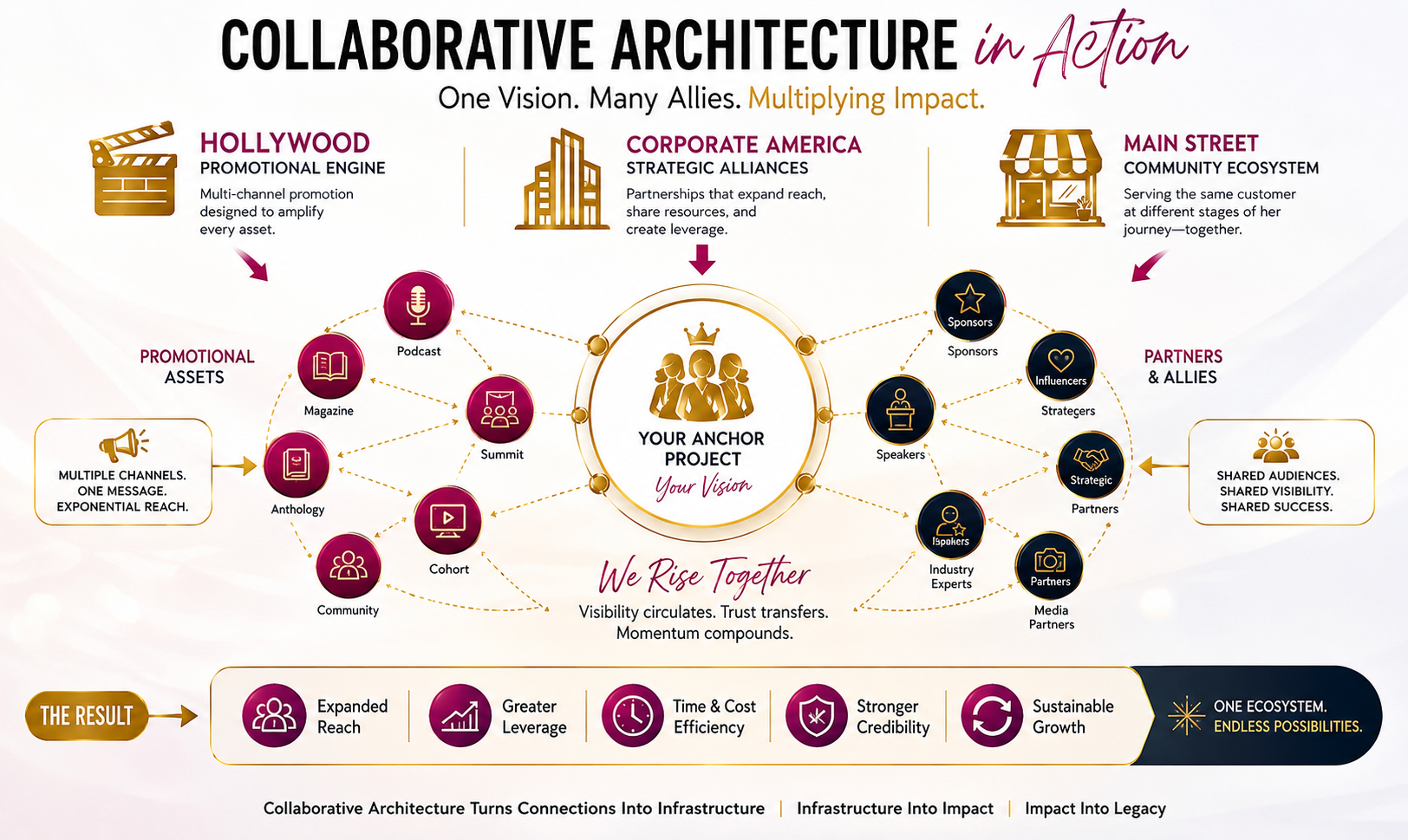
Growth becomes more efficient when it is distributed across a network rather than carried by an individual.
The Badass Boardroom applies the same principle to women building businesses, communities, thought leadership platforms, and collaborative projects.
The objective is not simply to work together.
The objective is to create a structure where every participant expands the reach, influence, and opportunity available to everyone else.
We Didn't Invent These Models. We Reverse-Engineered Them.

Hollywood uses them to launch movies.
Corporate America uses them to launch products.
Franchises use them to scale locations.
Communities have used them for generations to raise barns, organize events, and mobilize support.
The innovation is not the model. The innovation is translating these models into a collaborative operating system for women building modern businesses on LinkedIn.
The Badass Boardroom is not built on networking tactics.
It is built on the same collaborative growth models used by Hollywood, Corporate America, franchises, community organizations, and major cultural movements.
Inside the Boardroom, members learn how to apply Barn Raising Marketing, Ecosystem Marketing, Transmedia Storytelling, Cultural Moment Marketing, Tentpole Marketing, Syndication Marketing, Franchise Marketing, and Event-Based Marketing to their own projects.
What This Book Actually Teaches
This book breaks down how collaborative systems function in practice, translating proven models into structured campaigns, shared audience activation, and coordinated launch ecosystems. It is designed to give women a clear operating picture of large-scale visibility before they step into the Boardroom itself.
Where Frameworks Become Infrastructure
Inside The Badass Boardroom, these frameworks are not studied as theory. They are implemented as infrastructure, giving women the tools to activate existing networks, borrow audiences, share resources, and build co-marketing campaigns that generate momentum no single business could produce alone. As the tribe grows, relationships compound and collaborative reach expands over time.
The Companion Resource
The methodology is supported by a companion resource: Stack Audiences: The Co-Marketing Architecture Hollywood, Corporate America, and Main Street Have Always Used, And What It Means for Women Building Online. The models are not new. The opportunity is applying them intentionally. Read the book above.
The Operating System Behind the Boardroom
For generations, organizations have used collaborative infrastructure to expand reach and accelerate growth. The Badass Boardroom translates those same principles into a practical operating system for women building modern businesses, communities, and thought leadership platforms.
Join The Badass Boardroom, starting with the $297 Activation Experience and $97 a month after, and begin building the ecosystem that makes every future launch easier, stronger, and more sustainable than the one before it.
Why Most Women's Business Communities Never Reach This Level
Most organizations stop at networking.
They help women meet.
Networking creates relationships
Networking introduces people
Networking produces conversations
The Badass Boardroom Goes Further
We help women mobilize.
Collaborative architecture creates outcomes
Collaborative architecture gives a shared mission
Collaborative architecture produces coordinated visibility, shared authority, and distributed growth
That distinction changes everything.
Have You Been Burned by Collaboration Before?
If so, you are not alone.
Many accomplished women arrive at The Badass Boardroom carrying stories of partnerships that did not work.
A collaborator failed to follow through.
Responsibilities became unbalanced.
One person carried most of the promotional burden.
The project succeeded for someone else but delivered little value in return.
The experience created frustration, disappointment, and skepticism about collaboration itself.
The problem is that most of these situations were never designed as collaborative ecosystems.They were designed as one-time promotional arrangements.
Someone had an event.
Someone needed exposure.
Someone asked for support.
Everyone agreed to help.
Then the entire effort depended on individual motivation and goodwill.
When one person stopped contributing, the structure collapsed.
No shared infrastructure existed.
No long-term opportunity was created.
No ecosystem emerged from the effort.
When the project ended, the collaboration ended with it.
That is not collaborative architecture.
That is shared activity without shared investment.
Inside The Badass Boardroom, we approach collaboration differently.
We focus on building ecosystems where every participant has a vested interest in the success of the initiative, the relationships, and the opportunities that follow.
Instead of asking:
"Who can help me promote my project?"
We ask:
"How do we build something together that creates value for everyone involved?"
That shift changes everything.
Before writing off collaboration entirely, consider these questions:
Did everyone have something meaningful to gain from the project's success?
Did we create something together, or were we simply promoting someone else's initiative
Did the collaboration strengthen future opportunities for everyone involved?
Were responsibilities aligned with each participant's strengths and resources?
If the project had become wildly successful, would everyone have benefited?
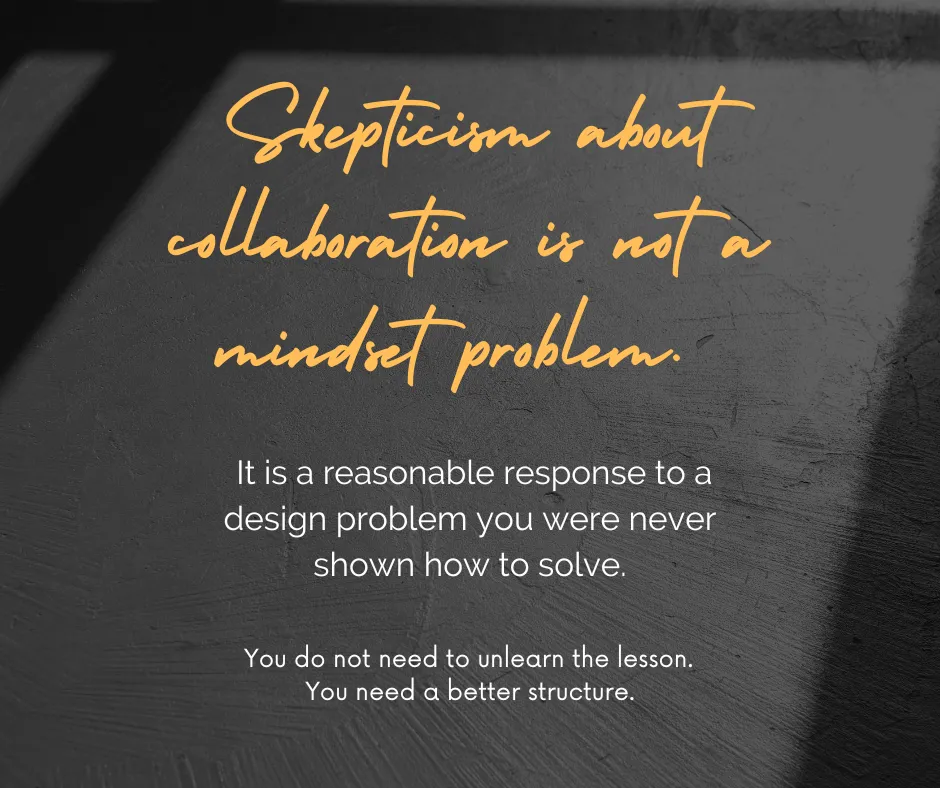
If the answer to most of these questions is no, collaboration may not have failed.
The design failed.
That distinction matters.
Because when collaborative ecosystems are structured correctly, every participant contributes value, every participant gains value, and every project strengthens the relationships, visibility, and opportunities that make the next initiative easier to build.
The goal is not simply to collaborate.
The goal is to build an ecosystem where collaboration becomes sustainable, repeatable, and mutually beneficial over time.
Collaboration did not fail.
The structure failed.
The Badass Boardroom was created to help accomplished women move beyond transactional partnerships and build collaborative ecosystems designed to generate shared visibility, shared opportunity, and shared success over time.
Join The Badass Boardroom, starting with the $297 Activation Experience and $97 a month after, and start building the kind of tribe you wish had existed when you launched your last project.
How Women Can Use Collaborative Architecture to Scale Beyond Their Individual Reach

Most women attempt to grow by increasing their individual output.
They create more content.
Attend more networking events.
Launch more offers.
Promote more frequently.
Work longer hours.
The problem is that individual effort has natural limits.
There are only so many audiences you can reach, introductions you can make, relationships you can maintain, and projects you can execute on your own.
Collaborative architecture operates differently.
Instead of relying solely on individual capacity, women intentionally combine complementary expertise, audiences, platforms, relationships, and resources to create opportunities that would be difficult to achieve independently.
Consider what happens when one woman launches a summit designed to help women in their 50s transition from corporate careers to entrepreneurship.
On her own, she can build a valuable event.
But when collaborative partners become part of the architecture, the scale expands significantly.
A podcaster joins the initiative, transforming the summit into a multi-channel content platform that reaches listeners before, during, and after the event.
A magazine publisher contributes long-form editorial coverage that captures key insights, elevates participant visibility, and extends the lifespan of the content.
A cohort leader develops a structured implementation experience, helping attendees move beyond inspiration and into action.
What began as a single event now functions as an interconnected ecosystem.
The summit attracts the audience.
The podcast amplifies the message.
The magazine extends authority.
The cohort deepens transformation.
Each partner contributes a unique asset while benefiting from the collective visibility, credibility, and audience expansion created by the collaboration.
This is where scale begins to separate from competition.
Most businesses attempt to grow by increasing effort.
Collaborative ecosystems grow by increasing leverage.
Inside The Badass Boardroom, members learn how to identify complementary projects, align strategic allies, stack audiences, and
cross-pollinate micro-tribes to create opportunities that are larger, more visible, and more resilient than any individual effort could produce alone.
The objective is not simply collaboration.
The objective is building an ecosystem capable of expanding reach, accelerating growth, and creating competitive advantages that are difficult for isolated competitors to replicate.
Is The Badass Boardroom Right for You?
The Badass Boardroom was built for women who are already accomplished, already connected, and already building something worth amplifying.
You do not need a larger audience.
You do not need another networking group.
You do not need another course filled with information you will never implement.
You need a collaborative infrastructure capable of turning relationships into coordinated action.
The Badass Boardroom was not built for women who want more networking opportunities.
It was built for women prepared to evolve beyond the Solopreneur model and begin operating as Allypreneurs — women who understand that relationships, collaboration, audience access, and shared infrastructure are among the most valuable business assets they possess.
This may be the right room for you if:

You Are Building an Anchor Project
You are actively building or planning a summit, cohort, membership, anthology, podcast, community, event, book project, or thought leadership initiative that can serve as the catalyst for a larger collaborative ecosystem.

You Are Willing to Contribute Before You Need Support
The strongest tribes are built through reciprocity. You are willing to show up for other women knowing they will do the same for you.

You Already Know Exceptional Women
You may not realize it yet, but the first members of your tribe are likely already sitting inside your LinkedIn network.

You Believe Relationships Are Business Assets
You understand that introductions, partnerships, referrals, audiences, credibility, and trust are forms of capital.

You Want to Build an Ecosystem, Not Just a Launch
You are interested in creating long-term collaborative infrastructure rather than chasing one-time promotional opportunities.

You Are Ready to Stop Building Alone
You recognize that modern growth is increasingly collaborative and that the most resilient businesses are built through aligned ecosystems rather than isolated effort.
If you found yourself nodding while reading this page, you are likely exactly who we built The Badass Boardroom for. The women who thrive in the next economy will not be those with the largest audiences.
They will be the women who know how to activate relationships, align resources, and build ecosystems that create value far beyond what any one person could produce alone.
If that is the future you want to build, your seat is waiting.
Join The Badass Boardroom.
Your Membership Includes
Starting with the $297 Allypreneur Activation Experience, then $97 per month after, you receive access to:
Monthly Barn Raising Marketing working sessions
Collaborative campaign planning workshops
The Doubling Penny Tribe Building framework
LinkedIn Refresher sessions
Tribe activation and Rolodex mining sessions
Syndicate role identification and deployment
Virtual business potlucks and cross-pollination mixers
Co-working and implementation sessions
Access to women building collaborative ecosystems around summits, anthologies, podcasts, retreats, memberships, cohorts, communities, and thought leadership initiatives.
Ongoing ecosystem support and strategic guidance
This Is Not a Course
It is not a networking organization.
It is not a passive membership community.
It is a working environment designed to help women build collaborative infrastructure around projects that matter.
Entry: $297 Allypreneur Activation Experience Then $97 per month to keep building your tribe
Your First Assignment Begins Before Your First Meeting
Identify the two women you would trust to help raise your barn.
Not someday.
Today.
The next collaborator.
The next speaker.
The next promotional partner.
The next sponsor.
The next referral source.
The next strategic ally.
The next woman who can help move your project forward.
The challenge is not finding them.
The challenge is creating the structure that allows everyone to work together.
That is what The Badass Boardroom was built to do.
You bring the vision.
You bring two trusted allies.
Together, we build the tribe, activate the network, distribute the workload, and create the collaborative infrastructure that helps projects grow.
Stop waiting for introductions.
Stop launching alone.
Start building the Brand Partnership Infrastructure your business needs to scale.
What Happens During Month One?
Most women join business communities and spend months trying to figure out where they fit.
The Badass Boardroom begins differently.
You arrive with a project.
You identify two trusted women from your LinkedIn network.
Then we start building.

Week One: Seed Your Tribe
Your first assignment is simple.
Identify two women you trust.
Not the most famous women.
Not the women with the largest audiences.
The women most aligned with your values, vision, and willingness to collaborate.
These women become the founding members of your tribe.
Together, you begin mapping the relationships, resources, expertise, and opportunities already sitting inside your collective LinkedIn networks.

Week Two: Build Your First Prime Tribe
Each of your two founding allies identifies two additional women from her LinkedIn Rolodex.
By the end of Month One, your tribe consists of six strategically aligned women working together inside a shared ecosystem.
You are no longer operating with one audience, one perspective, or one network.
You are building a collaborative infrastructure designed to expand reach, authority, and opportunity.

Week Three: Assign the Syndicate Roles
Every successful barn raising depends on distributed responsibility.
Inside the Boardroom, your tribe identifies the strengths each woman brings to the table.
Some women are Architects.
Others are Connectors.
Others are Amplifiers, Storytellers, Hosts, Foremen, or Archivists.
Instead of everyone trying to do everything, each woman contributes where she creates the greatest value.
The workload becomes distributed.
The momentum becomes shared.

Week Four: Activate the Tribe
This is where theory becomes execution.
Your tribe participates in collaborative working sessions designed to activate the network you already have.
Together, you:
Mine LinkedIn for potential collaborators, speakers, sponsors, and referral partners
Participate in LinkedIn Refreshers to strengthen positioning and visibility
Co-create content that blends expertise and promotes your projects
Identify cross-promotional opportunities
Develop collaborative ecosystem opportunities that connect multiple projects, audiences, and platforms.
Build the foundation for future launches, partnerships, and ecosystem growth
By the End of Month One

You have more than a membership.
You have a tribe.
You have identified strategic allies.
You have assigned roles.
You have activated dormant relationships.
You have strengthened your LinkedIn presence.
You have begun building collaborative campaigns.
Most importantly, you have stopped carrying the weight of growth alone.
And this is only the beginning.
Every month thereafter, the tribe expands, relationships deepen, visibility compounds, and the ecosystem grows stronger.
That is the power of the Doubling Penny methodology.
Small beginnings.
Compounding momentum.
Extraordinary outcomes.
Build Your Tribe!
Activate your network.
Stop waiting for the perfect introduction.
Stop waiting for someone else to open the door.
Stop rebuilding momentum from scratch with every new project.
The relationships you need may already be in your network.
The opportunity is creating the structure that allows everyone to move together.
Join The Badass Boardroom
Choose your two allies.
Claim your seat.
Let's start building your tribe.
Frequently Asked Questions
How is the Badass Boardroom different from traditional networking?
The easiest way to understand the difference is to look at how successful businesses operate on Main Street.
Imagine a corridor filled with businesses serving homeowners.
→ A real estate agency helps a family buy a home.
→ A contractor helps them renovate it.
→ A flooring company helps them update it.
→ A furniture store helps them furnish it.
→ A lighting showroom helps them personalize it.
→ A landscaping company helps them complete it.
At first glance, these businesses appear unrelated.
In reality, they are part of the same customer journey.
The homeowner moves from one need to the next, and each business benefits from serving her at a different stage of that journey.
The most successful business districts understand this.
→ They do not operate as isolated businesses competing for attention.
→ They build distribution infrastructure.
→ They create shared directories.
→ They participate in community events.
→ They cross-promote one another.
→ They exchange referrals.
→ They develop partnership programs.
→ They intentionally keep customers circulating within the ecosystem rather than allowing every business to acquire customers independently from scratch.
No single business carries the full promotional burden alone.
The ecosystem carries it collectively.
Most online business owners operate very differently.
→ They build audiences independently.
→ Create content independently.
→ Launch independently.
→ Promote independently.
→ And then repeat the entire process for the next project.
The Badass Boardroom applies the same ecosystem principles that have worked on Main Street for generations.
Instead of viewing other women as competitors, members learn how to identify women who serve the same audience at different stages of the buyer journey.
A summit host may partner with a podcaster.
A cohort leader may partner with a membership owner.
An anthology publisher may partner with a retreat facilitator.
Each woman contributes a different piece of the transformation while benefiting from shared visibility, shared relationships, shared opportunities, and shared audience access.
The goal is not simply to network.
The goal is to build the digital equivalent of a thriving Main Street business district—a collaborative ecosystem where opportunities, referrals, audiences, and visibility circulate through intentional design rather than isolated effort.
That is the difference between networking and collaborative architecture.
One creates connections.
The other creates infrastructure.
How is the Badass Boardroom different from a mastermind or a networking group?
This question deserves a structural answer, not a positioning one — because the difference is not about tone or community culture. It is about what each format is actually designed to produce.
A mastermind is designed to produce strategic clarity through peer advisory. Members bring problems, the group offers perspective, and the owner leaves with better thinking. What she does not leave with is a mapped ecosystem of strategic allies, a coordinated launch infrastructure, or a structured framework for expanding audience access through collaborative relationships.
A networking group is designed to produce introductions. Members meet, exchange business cards or LinkedIn connections, and expand their contact lists. What they do not receive is a methodology for identifying audience overlap, activating complementary projects, or building long-term collaborative ecosystems that support multiple initiatives over time.
The Badass Boardroom is designed to produce one thing: collaborative launch ecosystems that compound visibility, expand audience access, reduce acquisition costs, and create momentum that extends beyond any single launch.
It does this through Cluster Mapping, Ally Sprints, the Partner Portfolio, and structured micro-alliance formation — four operational mechanisms designed to help women transform existing relationships into coordinated growth infrastructure.
The Boardroom is not a better mastermind.
It is a different category of investment entirely.
I already have a network. Why do I need this?
You do have a network. This is not in question.
The question the Badass Boardroom is designed to answer is a different one: of the hundreds of connections in your existing LinkedIn network, how many of them have you identified as having an audience that overlaps yours by 70 percent or more? How many of their offers are adjacent to yours — positioned at a different stage of the same transformation journey your buyer takes? How many of them have you approached with a structured, reciprocal co-marketing proposal that benefits both parties' revenue?
For most women, the honest answer to all three questions is: very few, if any.
This is not a failure of effort or relationship-building instinct. It is a failure of methodology. Without a structured process for mapping your network against your buyer's profile, without a platform for making co-marketing proposals that feel natural rather than transactional, and without a community of women who have committed to the same reciprocal model, the network stays exactly what it is — a contact list that generates zero compound return.
The Cluster Mapping Sprint in Month One takes the network you have already built and does something you have never had a structured process for doing: it maps it. Ninety minutes. Three to five women identified whose audiences overlap yours by 70 percent or more, whose offers stack naturally with yours, and who are positioned to become your highest-value co-marketing allies.
You do not need a bigger network. You need to see the one you have with new precision.
What exactly happens each month — walk me through it specifically?
Month One is distinct from every month that follows because it is the ecosystem-building month. Everything that happens in subsequent months sits on what Month One produces.
Month One — The Cluster Mapping Sprint runs in Week Two. This is a live, guided ninety-minute session in which you apply the four-step Cluster Mapping process to your LinkedIn network — defining your Audience Fingerprint, auditing your top connections, surfacing cluster overlaps, and identifying the three to five women most strategically positioned to become collaborative allies.
You leave Month One with names, strategic alignment criteria, and a framework for initiating alliance conversations.
Month One also includes your first Ally Sprint — a structured LinkedIn activation session in which members deliberately engage with one another's content, increasing visibility, authority, and reach across the network.
Month Two onward follows a consistent monthly rhythm:
Week One: Ally Sprint — structured LinkedIn activation. Members coordinate engagement across one another's content in a defined window, compounding visibility for every participant.
Week Two: Launch Ecosystem Workshop — members bring active initiatives such as summits, cohorts, retreats, anthologies, podcasts, memberships, or communities. Together, the group builds the ecosystem around the initiative by identifying audience-sharing opportunities, strategic allies, complementary projects, promotional assets, and visibility pathways.
Week Three: Partner Portfolio Drop — new Partner With Me Requests are distributed. Members review opportunities from women whose Business DNA complements their own and respond to requests aligned with their current priorities.
Week Four: Micro-Alliance Check-In — alliance partners review commitments, report on activity, coordinate upcoming opportunities, and identify additional ecosystem-building opportunities.
By Month Three, the compounding effect becomes visible in measurable ways: stronger LinkedIn visibility, increased partner-driven traffic, expanded audience access, and reduced reliance on solo promotion.
This is not a community you join and watch.
It is a collaborative ecosystem you actively build and operate inside.
How does Cluster Mapping actually work — and what if my network is not large enough?
Cluster Mapping is a four-step process that can be completed in ninety minutes and repeated quarterly as your network grows and your partnerships evolve.
Step 1: Audience Fingerprint
Define your buyer's five core characteristics with precision: her age and experience level, her biggest business frustration, the offer type she actively buys, the content she consumes, and the transformation she is seeking. This is the comparison template every connection in your network is evaluated against.
Step 2: Network Audit
Review your LinkedIn connections and tag each one against three dimensions: audience match (does her audience share 60 percent or more of your Fingerprint characteristics?), offer adjacency (does her offer occupy a different stage of the same transformation journey?), and authority alignment (does her LinkedIn presence signal the caliber of expertise your audience respects?).
Step 3: Cluster Reveal
Apply the tags and the overlaps surface. Connections that appeared unrelated begin to group — women who serve the same audience segment from different angles, whose collective reach into that segment is substantially larger than any individual reach.
Step 4: Alliance Activation
Select three to five women from each cluster for micro-tribe formation and approach them with a structured co-marketing proposal: one campaign per quarter, coordinated promotion across all cluster audiences, shared assets, reciprocal commitment.
On the question of network size: the methodology works with 200 connections and it works with 2,000. What matters is not the volume of connections but the precision of the mapping. A woman with 300 strategically accumulated connections in her specific professional domain will surface more high-quality cluster matches than a woman with 3,000 connections accumulated across twenty years of unrelated professional activity.
Additionally, the Partner Portfolio operates independently of your existing network size. Partner With Me Requests come inbound to you from women inside the broader Female Ally Economy ecosystem — which means your co-marketing reach extends beyond your current connection list from the moment you access the platform.
The ceiling on what Cluster Mapping can surface is determined by the quality of your existing connections, not the quantity. Most women are surprised by what ninety minutes of structured mapping reveals.
I have been in communities that overpromised and underdelivered. Why is this different?
This question deserves the most direct answer in the document, because the scar tissue it reflects is real and it was earned honestly.
Most online communities fail for one of three structural reasons. The first is that they are built around content delivery rather than operational activation — members receive training, courses, and frameworks, but the application of those frameworks happens alone, after the call ends, without structural support. The second is that they rely on member goodwill to sustain engagement — when the initial enthusiasm fades, the community fades with it, because there is no operational mechanism that requires consistent participation. The third is that the value proposition depends on the host's ongoing presence and energy — when the host's attention shifts, the community hollows out.
The Badass Boardroom is designed around three structural features that prevent each of these failure modes specifically.
— Operational activation, not content delivery. The Ally Sprints, Cluster Mapping sessions, Partner Portfolio drops, and co-marketing campaign architecture are active monthly mechanisms — not content to consume but systems to operate inside. The value is generated by operating the system, not by watching someone explain it.
— Reciprocal commitment as the structural backbone. Every micro-alliance formed inside the Boardroom is built on a reciprocal promotion commitment — your promotion powers her launch, her promotion powers yours. This creates an ongoing operational reason for every member to participate consistently, independent of community enthusiasm or host energy.
— The Partner Portfolio as an evergreen value mechanism. New Partner With Me Requests arrive monthly regardless of whether any individual member is actively engaged in alliance formation. The platform continues to deliver value between live sessions and across the natural ebb and flow of every member's business calendar.
None of this eliminates the possibility that the Boardroom is not the right fit for a specific woman at a specific moment. But the structural failure modes that eroded the communities you have previously invested in are not present here, because the design explicitly accounts for them.
The Boardroom's retention depends on results, not enthusiasm. That is a different kind of community.
How does the Partner Portfolio help me build a launch ecosystem?
The distinction matters because most women do not struggle to find people.
They struggle to identify the specific relationships, complementary projects, and strategic allies capable of expanding the scale and reach of what they are building.
Most women already have part of an ecosystem.
They may have a summit, podcast, anthology, membership, cohort, retreat, community, newsletter, or speaking platform.
What is often missing are the complementary pieces that transform a standalone project into a collaborative growth engine.
That is where the Partner Portfolio becomes valuable.
A traditional directory is a passive listing. You create a profile, the directory publishes it, and you wait for someone to discover you. Discovery depends on search behavior and platform traffic.
A referral network is relationship-dependent. Someone in your network thinks of you when an opportunity arises and makes an introduction. The quality and frequency of those introductions depend entirely on existing relationships and timing.
The Partner Portfolio operates differently.
It functions as an ecosystem-building platform designed to connect women around active initiatives and clearly defined collaboration opportunities.
Rather than hoping the right person discovers you, women publish Partner With Me Requests tied to real projects they are actively building.
→A woman launching a summit may publish a request for speakers, promotional partners, sponsors, podcast hosts, or implementation experts whose audiences naturally overlap with hers.
→ Awoman producing an anthology may seek contributors, podcast interview opportunities, community leaders, or promotional allies who can help expand the project's reach.
→ A woman leading a cohort may look for referral partners, retreat hosts, subject matter experts, or membership community owners whose audiences are positioned for the next stage of the client journey.
The objective is not simply finding partners.
The objective is identifying the missing pieces of the ecosystem.
Requests are distributed to women whose Business DNA, expertise, audience, and project focus align with the stated opportunity.
Because the request is based on a specific initiative and a clearly defined need, conversations begin with strategic context rather than cold outreach.
This dramatically reduces the friction that typically accompanies collaboration.
Instead of spending months networking in the hope that the right opportunity eventually appears, members gain access to women who are actively looking for strategic allies right now.
The result is not merely another introduction.
It is the ability to identify complementary projects, stack audiences, share visibility, exchange resources, and build collaborative launch ecosystems that are larger, more differentiated, and more resilient than anything one business could create independently.
A directory helps people find you.
A referral network helps people recommend you.
The Partner Portfolio helps you identify the strategic allies, complementary projects, and audience relationships needed to build a launch ecosystem that extends beyond anything you could create alone.
Is this right for me if I am in the middle of a launch right now?
Yes — and the timing argument runs the opposite direction from the one you might expect.
The Badass Boardroom's co-marketing infrastructure is most valuable when you have an active launch, not after it completes. The Month One Cluster Mapping Sprint is designed to surface the allies whose audiences are most precisely matched to your current initiative — which means the women it identifies are the women whose promotion would have the highest conversion rate on the specific offer you are running right now.
Waiting until after the launch to join means the launch runs without the infrastructure. The acquisition cost for that launch remains entirely on your balance sheet. The peer-endorsed visibility that converts at two to three times the rate of solo promotion does not reach the prospects who would have benefited from it. The shared campaign assets that would have distributed your production cost across partner networks are not built.
The practical question is not whether you are mid-launch. It is whether the first Partner Portfolio drop and the first Ally Sprint — both of which occur in Month One — can produce co-marketing momentum for the initiative you are currently running.
For most women, the answer is yes. A co-promotional partnership that activates in Week Three of a launch still captures the final conversion window of that launch — and builds the relational infrastructure that makes the next launch's opening week significantly stronger.
The one scenario where timing genuinely warrants waiting is if your current launch closes in fewer than two weeks. In that case, the Month One infrastructure will not have time to produce results for the current initiative. Join immediately after it closes and the Cluster Mapping Sprint will orient directly toward whatever you are building next.
A launch in progress is not a reason to wait. It is a reason to move faster.
I am an introvert and not naturally relationship-forward. Will this work for me?
This question is asked less often than it is felt — which is why it belongs in this document explicitly.
The conventional collaboration model requires a woman to initiate relationships through social outreach, sustain them through consistent relational maintenance, and make asks that feel inherently transactional — all of which create significant friction for someone who processes relationally through depth rather than volume and who finds cold social initiation genuinely costly.
The Badass Boardroom's structural design reduces that friction at every point where it typically accumulates.
— Cluster Mapping replaces cold prospecting with precision identification. Instead of approaching connections speculatively, you approach the specific women the mapping has already confirmed are your highest-probability allies. The conversation begins with structural context rather than social awkwardness.
— The Partner Portfolio makes the first move for you. When you publish a Partner With Me Request, the women who respond are already self-selected as interested in co-marketing with you specifically. You respond to inbound interest rather than initiating outbound requests.
— Ally Sprints are structured and time-bounded. There is no requirement for spontaneous social engagement or sustained relational performance. The sprint has a defined window, a defined activity, and a defined end. You participate within the structure rather than navigating an open-ended social environment.
— Micro-alliances are small by design. Three to five women, selected for strategic complementarity, operating inside a reciprocal commitment structure. The relational depth that introverts build naturally — and that extroverts often skip in favor of volume — is precisely what makes micro-alliances compound over time.
The women who have historically found the largest co-marketing returns inside structured alliance models are often the ones who would never have described themselves as natural collaborators — because the structure does the social architecture work that they find most costly, and leaves them with the strategic and creative work they do best.
The Boardroom is not built for the woman who finds networking effortless. It is built for the woman who finds results essential. Those are often the same woman.
What is the Female Ally Economy and why does it matter to my revenue — specifically?
The Female Ally Economy is a collaborative economic model built on a simple premise: growth no longer needs to be carried alone.
It applies the same ecosystem-building principles used by Hollywood, Corporate America, franchises, chambers of commerce, and community organizations to create shared visibility, shared opportunity, and shared momentum.
The model is grounded in one structural observation: most women are operating inside solo acquisition systems.
→ Every launch begins from scratch.
→ Every promotion cycle depends on individual effort.
→ Every visibility initiative requires independent execution.
→ Every new project requires rebuilding momentum.
The result is rising costs, increasing workload, and diminishing leverage.
The Female Ally Economy replaces that model with collaborative launch ecosystems in which women intentionally align complementary projects, audiences, platforms, expertise, and relationships.
Instead of building isolated campaigns, they build ecosystems capable of supporting multiple initiatives over time.
The economic results mirror what successful co-marketing partnerships have produced for decades:
• Customer acquisition costs decrease because audience access is shared rather than purchased.
• Conversion rates increase because trusted introductions and peer-endorsed visibility outperform direct promotion.
• Production costs decrease because assets, expertise, and promotional infrastructure are shared.
• Authority compounds because multiple aligned voices reinforce one another's positioning.
• Growth becomes more sustainable because visibility no longer resets after every launch.
The Female Ally Economy matters to your revenue because it changes the structural conditions under which revenue is generated.
Instead of carrying the full burden of visibility, audience growth, and promotion alone, you operate inside an ecosystem where momentum, opportunity, and reach are distributed across aligned allies.
The Badass Boardroom is where this model becomes operational.
What happens if I join and decide it is not the right fit?
The Badass Boardroom is a monthly membership at $97 per month with no long-term contract requirement.
If after your first month you determine that the Boardroom is not the right operational fit for where your business is right now, you cancel. No penalty, no complicated exit process, no pressure to stay.
The more useful question — and the one worth examining before joining rather than after — is what 'not the right fit' would actually mean in practice. If it means the Cluster Mapping Sprint did not surface any viable allies, that outcome is worth understanding: it would indicate that your current LinkedIn network does not yet contain women whose audiences and offers are complementary to yours, which is itself a diagnostic finding about where your network-building energy should be directed. If it means the Ally Sprints did not produce visible LinkedIn momentum, the question is whether the sprint cadence was followed with the consistency the methodology requires.
Most women who leave a structured co-marketing model do not leave because the model does not work. They leave because their business is not yet at the stage where consistent monthly co-marketing investment produces the compound return the model is designed to generate — which is a timing issue, not a model issue.
The Boardroom is built for women who have premium initiatives, established networks, and the operational bandwidth to execute one coordinated co-marketing campaign per month. If those three conditions are present, the model works. If they are not yet fully present, the honest answer is to note when they will be and join at that point rather than at this one.
The Boardroom is month-to-month because the results should make you want to stay — not because a contract requires it.
What does success look like after six months?
Six months from now, success is not measured by how many meetings you attended.
It is measured by the ecosystem you have built.
A successful Boardroom member has:
→ Identified strategic allies inside and beyond her LinkedIn network
→ Formed active micro-alliances around complementary projects
→ Expanded access to audiences she could not reach alone
→ Increased visibility through coordinated promotion
→ Strengthened her LinkedIn authority through Ally Sprints
→ Reduced dependence on solo marketing efforts
→ Created ongoing opportunities for referrals, partnerships, speaking engagements, and collaborative projects
Most importantly, she is no longer launching in isolation.
She has built a collaborative ecosystem capable of supporting multiple initiatives, expanding opportunities, and creating momentum that compounds over time.
That is the difference between running a launch and building an ecosystem.
FAQS
What differentiates Smart Women Partner & Grow Rich from other collaborative marketing consultancies?
Most collaborative marketing firms help businesses create partnerships.
We help women build collaborative ecosystems.
Smart Women Partner & Grow Rich is the architectural arm of the Female Ally Economy—a collaborative growth model that helps accomplished women transform existing relationships, communities, and expertise into interconnected business infrastructure.
Our work is built around a simple belief:
The future of business growth will not belong to the women with the biggest audiences. It will belong to the women who build the strongest ecosystems.
That philosophy shapes everything we do.
We Partner with Women Who Are Already Gathering Women
Our ideal clients are not entrepreneurs starting from scratch.
They are women who have already built something valuable:
→ Summits
→ Podcasts
→ Memberships
→ Cohorts
→ Anthologies
→ Masterminds
→ Certification programs
→ Leadership communities
→ Professional networks
These leaders have already earned trust.
They have already gathered audiences.
They have already created meaningful experiences.
Their challenge is not attracting more people.
Their challenge is activating the relationships surrounding those projects and sustaining momentum after the program ends.
That is where we come in.
We Don't Teach LinkedIn. We Mobilize LinkedIn Networks.
Most LinkedIn consultants teach profiles, content, and platform features.
Our work begins after those fundamentals.
Our signature LinkedIn Refresher Activation Experience helps speakers, sponsors, guests, authors, members, and participants activate the professional relationships they have spent decades building.
The result is not simply better LinkedIn activity.
It is a coordinated network of LinkedIn Ambassadors who amplify the host's project while creating new opportunities for their own businesses.
Our value proposition is simple:
We don't teach women how to use LinkedIn. We mobilize the LinkedIn networks they already spent decades building for the benefit of your project as well as their own businesses.
We Build Collaborative Infrastructure—Not One-Time Campaigns
Traditional collaborative marketing often focuses on individual partnerships or short-term promotions.
We build systems that continue creating value long after an event, launch, or cohort concludes.
Our collaborative infrastructure includes:
→ Relationship activation
→ Audience stacking
→ Strategic partner ecosystems
→ Niche Labs
→ Collaborative visibility campaigns
→ Cross-community introductions
→ Executive ecosystem design
The objective is not simply to help women collaborate once.
It is to help them build businesses where collaboration becomes an ongoing competitive advantage.
We Connect Ecosystems Instead of Building Silos
Most organizations concentrate on growing their own community.
We help leaders strengthen their community by connecting it to complementary ecosystems.
Rather than asking every woman to solve every challenge alone, we help ecosystem builders share expertise, audiences, opportunities, and visibility.
A summit becomes connected to a podcast.
A podcast introduces members to a cohort.
A cohort creates contributors for an anthology.
An anthology produces speakers for another summit.
Every relationship continues generating value because the ecosystem continues expanding.
We Build Executive-Level Growth Infrastructure
Our work extends beyond marketing.
We help accomplished women design collaborative business architecture.
Through B2B Women Collaborate, the Partner Portfolio, and the Badass Boardroom, women learn how to transform individual projects into sustainable ecosystems supported by strategic partnerships, Relationship Capital, and shared visibility.
The goal is not simply to grow a business.
It is to build an environment where opportunities continue circulating long after a single launch or event.
The Strategic Difference
Most collaborative marketing consultancies help businesses find partners.
→ We help accomplished women become ecosystem builders.
→ We activate the relationships they already have.
→ We strengthen the communities they have already built.
We connect those communities to complementary ecosystems.
And we help transform LinkedIn from a passive network of professional contacts into collaborative growth infrastructure.
That is the difference.
That is the foundation of the Female Ally Economy.
And that is how accomplished women stop building isolated businesses and begin creating connected ecosystems capable of generating long-term visibility, opportunity, and economic growth.
What is a Co-marketing?
Below is a refined, elevated version that aligns more explicitly with your Female Ally Economy framework while maintaining clarity and authority.
Co-marketing is a structured growth strategy in which two or more non-competing businesses align their audiences, authority, and promotional assets to engineer shared visibility and mutual market expansion.
At its core, co-marketing replaces isolated promotion with coordinated amplification. Instead of operating independently within fragmented ecosystems, aligned partners integrate their reach, expertise, and platforms to produce outcomes that exceed what any single brand could generate alone.
This collaboration may take the form of:
→ Co-branded webinars or live events
→ Joint lead magnets or content series
→ Stacked launches
→ Cross-promotional visibility campaigns
→ Strategic introduction exchanges
However, co-marketing is defined less by format and more by structure.
It is not a casual collaboration. It is not a one-time shout-out. It is not sponsorship, affiliate marketing, or transactional exposure.
Co-marketing is intentional alignment.
Partners synchronize efforts to:
→ Expand audience penetration through network overlap
→ Reinforce authority through association with complementary expertise
→ Accelerate campaign momentum through coordinated visibility
→ Distribute promotional effort while compounding impact
When executed strategically, co-marketing converts relationship capital into visibility capital. It strengthens positioning, shortens trust-building timelines, and generates recurring collaboration pathways.
In today’s saturated digital landscape, isolated marketing creates incremental results. Structured co-marketing creates multiplicative outcomes.
It is not simply shared promotion.
It is engineered amplification.
And when embedded within a larger relational infrastructure—such as the Female Ally Economy—it becomes a repeatable system for compounded authority and coordinated growth.
Sales Are Vanity, Profits Are Sanity — Co-Marketing Makes the Difference!
Revenue is a visible metric. Profit is a strategic metric.
A business can generate six or seven figures in sales and still operate with fragile margins if customer acquisition costs, advertising spend, and isolated marketing efforts consume the majority of its earnings. Top-line revenue may signal activity. It does not guarantee sustainability.
Co-marketing restructures this equation.
Rather than funding growth alone, strategic partners align audiences, authority, and promotional infrastructure to reduce acquisition costs while expanding reach. The result is not inflated exposure, but improved margin performance.
When executed with intention, co-marketing delivers measurable financial advantages:
→ Higher conversion efficiency. A single aligned partner can introduce your offer to a pre-qualified, trust-based audience, compressing the sales cycle and increasing close rates without incremental ad spend.
→ Lower production and campaign costs. Shared events, content assets, and promotional initiatives distribute operational expenses across multiple contributors while maintaining premium positioning.
→ Compounded credibility. Peer alignment reinforces authority, which strengthens enrollment quality, improves retention, and stabilizes long-term revenue streams.
In contrast to solo marketing—where each launch resets the visibility cycle and reacquires attention from scratch—co-marketing builds cumulative trust. Every collaboration reinforces positioning. Every aligned campaign expands network penetration. Every shared initiative reduces redundant effort.
This is not a visibility tactic.
It is margin engineering.
Co-marketing shifts the focus from vanity metrics to economic durability. Instead of chasing impressions, you build coordinated campaigns that convert more efficiently, cost less to execute, and generate profit that compounds over time.
Sales may create headlines.
Profit builds businesses.
Strategic co-marketing makes the difference.
Why does Smart Women Partner & Grow Rich emphasize profit over visibility?
Because revenue without margin is performance theater.
In traditional marketing models, women are taught to chase reach, impressions, and top-line sales. But high revenue paired with high acquisition costs, ad dependency, and isolated launch cycles erodes profitability. Visibility becomes expensive. Momentum becomes fragile.
The Female Ally Economy was built to correct that imbalance.
Inside this model, co-marketing is not a promotional tactic. It is margin engineering.
Rather than funding growth alone, aligned women coordinate visibility, referrals, and launch infrastructure. Audience trust is shared. Production costs are distributed. Authority is reinforced through strategic association. Customer acquisition becomes relational rather than transactional.
The result is economic leverage:
→ Higher conversion rates through warm, pre-qualified introductions
→ Reduced campaign costs through shared execution
→ Compounded authority that strengthens retention and long-term revenue stability
→ Lower dependency on paid acquisition
This is the core principle of the Female Ally Economy:
Authority compounds. Acquisition costs decrease. Profit margins strengthen.
Sales may create headlines.
Structured collaboration creates sustainability.
Smart Women Partner & Grow Rich does not optimize for attention spikes.
It builds relational infrastructure that converts proximity into profitable growth.
That is the difference between visibility and economic durability.
What is Tribal Marketing?
Tribal Marketing is a strategic growth approach that organizes business expansion around identity-based belonging rather than demographic targeting. It activates emotionally bonded communities—“tribes”—united by shared values, lived experiences, aspirations, and worldview.
These tribes are not casual audiences.
They are psychologically aligned ecosystems that rally around a common belief system, cultural narrative, or professional identity.
Unlike traditional marketing, which segments by age, income, or geography, Tribal Marketing operates at the level of identity and affiliation. It does not merely sell an offer—it reinforces who the customer believes she is.
→ Harley-Davidson riders are not buying motorcycles.
→ CrossFit enthusiasts are not buying gym memberships.
→ Eco-conscious beauty consumers are not buying cosmetics.
They are reinforcing identity.
That is the power of tribal alignment.
The Core Mechanics of Tribal Marketing
1. Identity Before Offer
Tribal Marketing affirms belonging before presenting products. The message is not “Buy this.” It is “This is who we are.”
2. Community as Distribution
Communication shifts from brand-to-consumer to tribe-to-tribe. Members organically circulate messaging because it reinforces shared identity.
3. Narrative Integration
Brands do not broadcast from outside the community. They embed themselves into the stories the tribe already tells about itself.
4. Ritual and Cultural Signals
Shared language, insider terminology, rituals, and collective experiences create cohesion. Tribal Marketing strengthens these signals rather than diluting them.
When executed correctly, customers transform into advocates. Visibility becomes relational rather than transactional.
Tribal Marketing Inside the Female Ally Economy
Within the Female Ally Economy, Tribal Marketing is not simply a consumer tactic—it is professional infrastructure.
Seasoned B2B women 50+ are not building generic audiences.
They are cultivating micro-communities of aligned operators—women who share professional ethos, visibility philosophy, and economic intention.
In this context:
Belonging increases trust velocity
Trust velocity increases conversion efficiency
Conversion efficiency protects profit margins
This is not emotional branding for its own sake.
It is margin strategy through identity alignment.
Where Co-Marketing Enters the Equation
Tribal Marketing becomes exponentially more powerful when paired with structured co-marketing.
When two aligned tribes overlap, authority compounds.
When two complementary tribes coordinate, acquisition costs decrease.
Instead of acquiring new audiences from zero, brands access pre-qualified trust ecosystems.
Strategically aligned co-marketing allows businesses to:
→ Cross-pollinate tribal loyalty without diluting brand integrity
→ Embed deeper into trusted networks through relational transfer
→ Expand reach while maintaining cultural cohesion
→ Scale visibility without scaling paid spend
For example, a strategist serving women-led startups partnering with a podcast host whose listeners are seasoned female founders does not expand randomly. She enters a tribe already aligned with her values and positioning.
That is not exposure.
That is trust transfer.
Strategic Applications in Practice
Inside a coordinated tribal and co-marketing ecosystem, expansion looks like:
→ Co-Branded Authority Events
Summits, audio panels, editorial features, or curated masterminds that merge aligned tribes into a shared visibility moment.
→ Joint Narrative Assets
Collaborative newsletters, research pieces, and thought leadership content that speak the tribe’s language with cultural fluency.
→ Micro-Tribe Incubation
Smaller, high-trust clusters formed around specific initiatives, later expanding into larger authority ecosystems.
→ Value-Driven Campaigns
Purpose-centered collaborations rooted in shared belief systems—equity, sustainability, women’s economic empowerment—activating tribes through conviction rather than discounting.
The Economic Outcome
Tribal Marketing gives people a reason to belong.
Co-marketing gives them a reason to expand the circle.
Together, they do more than grow audiences.
They construct relational infrastructure.
Within the Female Ally Economy, this fusion transforms isolated operators into coordinated visibility clusters—where authority compounds, trust accelerates, and profit stabilizes.
It is not about building followers.
It is about activating aligned ecosystems.
And ecosystems outperform audiences every time.
How does Co-Marketing & Tribal Marketing intersect?
Tribal marketing and co-marketing intersect at the point where identity-based belonging meets structured relational amplification.
Tribal marketing organizes people around shared identity, values, and belief systems. Co-marketing organizes businesses around shared audiences and aligned economic goals. When integrated intentionally, they create coordinated ecosystems where trust, visibility, and authority compound rather than reset with every campaign.
This intersection is not promotional.
It is infrastructural.
The Strategic Intersection Points
1. Shared Identity Meets Shared Incentive
Tribal marketing activates communities bound by cultural alignment and purpose. Co-marketing aligns businesses that serve those same communities.
When two aligned operators coordinate, they are not merely sharing audiences—they are reinforcing a shared worldview. The tribe experiences consistency, not interruption. Authority strengthens because alignment is visible and coherent.
Inside the Female Ally Economy, this is how micro-tribes form: identity cohesion supported by coordinated partner infrastructure.
2. Emotional Belonging Meets Structured Amplification
Tribal marketing builds emotional attachment.
Co-marketing builds distribution pathways.
When combined:
→ Emotional loyalty increases conversion velocity.
→ Structured amplification increases visibility efficiency.
→ The result is not just engagement—it is profitable engagement.
Trust is no longer built from zero with each launch. It transfers across aligned partnerships, reducing acquisition costs and stabilizing margins.
3. Narrative Power Meets Network Architecture
Tribes are sustained through shared narratives.
Co-marketing expands those narratives through network architecture.
When collaborators co-create content, events, or campaigns, they are not broadcasting louder messages. They are weaving a shared story across interconnected communities.
This transforms isolated campaigns into coordinated authority events.
Within the Female Ally Economy, this is referred to as stacked visibility—where narrative continuity flows across aligned platforms instead of fragmenting.
4. Community-Led Growth Meets Partner-Driven Expansion
Both models reject passive consumption.
Tribal marketing encourages participation and belonging.
Co-marketing encourages partnership and co-creation.
Together, they produce community-powered expansion, where members circulate messaging organically and partners reinforce positioning structurally.
→ Growth becomes distributed.
→ Visibility becomes relational.
→ Momentum becomes compounding.
5. Trust Anchors Meet Credibility Transfer
Tribal leaders hold influence within their communities. Co-marketing leverages that influence through visible alignment.
When trusted authorities collaborate, credibility transfers across networks. Referral pipelines warm naturally. Decision cycles shorten.
This is not influencer marketing.
It is structured trust engineering.
The Economic Impact of the Intersection
When tribal marketing and co-marketing operate together, businesses move from transactional promotion to ecosystem design.
Instead of:
→ Buying attention
→ Resetting visibility with each launch
→ Competing for algorithmic spikes
They:
→ Activate aligned micro-communities
→ Coordinate amplification across partners
→ Convert relationship capital into structured visibility capital
The outcome is measurable:
→ Reduced acquisition costs
→ Increased conversion rates
→ Strengthened retention
→ Compounded authority
This is the core operating principle of the Female Ally Economy: identity-based belonging reinforced by coordinated relational infrastructure.
Tribal marketing builds the loyalty.
Co-marketing builds the leverage.
Together, they do not just grow audiences.
They construct durable, profit-generating ecosystems.
What is Velvet Rope Marketing?
Velvet Rope Marketing is a strategic positioning model that increases perceived value by controlling access. Rather than pursuing mass visibility, it curates proximity. Inspired by the controlled entry of high-status environments, velvet rope marketing signals that participation is selective, standards are elevated, and alignment is required.
It is not artificial scarcity.
It is strategic filtration.
At its core, velvet rope marketing leverages three psychological drivers:
→ Scarcity — Access is limited and intentional.
→ Status — Association elevates perceived authority.
→ Social Proof — Inclusion signals credibility.
The result is a shift in power dynamics. Your offer is no longer something to convince people to buy. It becomes something qualified individuals seek to enter.
In economic terms, velvet rope marketing protects margin by increasing positioning strength.
How Velvet Rope Marketing Complements Co-Marketing
Co-marketing expands reach. Velvet rope marketing elevates reach.
When integrated intentionally:
1. Exclusivity Becomes the Magnet
You are not simply sharing audiences. You are inviting aligned operators into a curated ecosystem. This transforms collaborative campaigns from promotional exchanges into high-status strategic alignments.
2. Partnerships Become Positioning Signals
Who you collaborate with communicates your standards. Curated co-marketing partnerships function as public endorsements of quality, discernment, and authority.
Within the Female Ally Economy, partnerships are not volume-based. They are value-based.
3. Campaigns Feel Like Entry Points, Not Broadcasts
Instead of generic promotions, collaborative initiatives are framed as access to a selective circle. This increases conversion strength because participants perceive opportunity—not marketing.
Velvet rope positioning ensures that co-marketing does not dilute brand authority through overexposure. It sharpens it.
How Velvet Rope Marketing Strengthens Tribal Marketing
Tribal marketing builds belonging. Velvet rope marketing protects and amplifies that belonging.
When integrated:
It Deepens Identity
Priority access, insider opportunities, and curated environments reinforce in-group cohesion. Members feel chosen, not marketed to.
It Elevates External Perception
When a tribe is perceived as selective and high-caliber, membership itself becomes status-enhancing. This increases organic demand and referral velocity.
It Preserves Cultural Integrity
Open-door ecosystems often dilute mission and standards. Velvet rope filtration ensures that new entrants align with the tribe’s values, protecting long-term cohesion.
Tribal marketing builds culture.
Velvet rope marketing protects cultural equity.
How Smart Women Partner & Grow Rich Integrates All Three
Smart Women Partner & Grow Rich operates at the intersection of:
Tribal Marketing (identity-based belonging)
Co-Marketing (structured relational amplification)
Velvet Rope Marketing (curated proximity and premium positioning)
Inside this architecture:
→The Partner Portfolio
The Partner Portfolio is intentionally curated. Entry is not passive. This velvet rope layer ensures alignment, seriousness, and contribution—protecting the economic integrity of the ecosystem.
→The Badass Boardroom
Micro-tribes are built through structured co-marketing clusters on LinkedIn. Tribal cohesion strengthens engagement. Velvet rope positioning ensures those clusters maintain authority and standards.
→ Premium Collaborative Campaigns
Initiatives are framed as strategic power circles, not open networking environments. Participation signals competence, readiness, and commitment to coordinated growth.
→ LinkedIn as Curated Infrastructure
Clients are coached to position their LinkedIn presence as a selective environment—where partnership is earned through alignment, not solicited through mass outreach.
Why Velvet Rope Marketing Matters Economically
Visibility without discernment erodes authority.
Access without filtration reduces margin.
When velvet rope marketing is combined with tribal cohesion and structured co-marketing, three outcomes emerge:
→ Authority strengthens
→ Conversion efficiency increases
→ Profit margins stabilize
The Female Ally Economy is not designed for mass exposure. It is designed for coordinated elevation.
You do not grow by being everywhere.
You grow by being intentional about who enters your proximity.
Velvet rope marketing ensures that growth is not only amplified—but protected.
Strategic Business Moments That Demand Collaboration
Revenue is a visible metric. Profit is a strategic metric.
A business can generate substantial top-line sales and still operate with fragile margins if acquisition costs, advertising dependency, and isolated marketing efforts consume the majority of its earnings. Activity does not equal sustainability.
Strategic collaboration restructures this equation.
A co-marketing campaign is not merely a promotional boost—it is a coordinated market-expansion strategy deployed at moments where leverage matters most. When aligned partners synchronize visibility, referrals, and launch efforts, authority compounds and acquisition costs decrease. Growth becomes structured rather than reactive.
Below are the business milestones where collaboration is not optional—it is economically intelligent.
1. New Product or Service Launches
Launching in isolation forces you to build awareness from zero, relying heavily on algorithms or paid acquisition to generate traction.
When partners coordinate launch visibility, you stack audiences instead of chasing impressions. Trust transfers through relational proximity, compressing the sales cycle and increasing close rates. Shared execution—events, campaigns, content—distributes cost while reinforcing collective authority.
The launch becomes synchronized activation, not isolated promotion.
2. Market Expansion
Breaking into new regions or sectors independently requires time-intensive credibility building.
Strategic alignment with partners already trusted in that market engineers immediate proximity. Instead of competing for fragmented attention, you enter through coordinated visibility channels. Authority compounds through association, accelerating relevance while minimizing spend.
Expansion becomes relational leverage, not advertising escalation.
3. Virtual Summits and Events
Events demand both audience volume and perceived authority.
When collaborators activate their networks in coordination, micro-communities function as growth engines. Registrations increase without multiplying ad budgets. Speakers amplify one another’s positioning, reinforcing expertise through association rather than volume.
The result is synchronized amplification rather than scattered promotion.
4. Book or Digital Course Launches
Educational offers require trust before transaction.
Coordinated introductions from aligned experts convert relationship capital into structured visibility capital. Joint programming positions the offer within an ecosystem of complementary authority, strengthening perceived value and improving enrollment quality.
Instead of competing for attention, collaborators align audiences around shared expertise.
5. Seasonal Campaigns and Holiday Promotions
High-traffic seasons often push brands into costly competition for visibility.
Strategic collaboration replaces noise with alignment. Bundled campaigns and coordinated messaging unify audiences around shared themes, reducing acquisition costs while increasing engagement. Rather than fragmenting efforts across platforms, partners create consolidated market presence.
Momentum becomes collective rather than competitive.
6. Brand Repositioning or Major Business Milestones
Rebrands and anniversaries require renewed authority signals.
Aligned partners reinforce positioning through coordinated messaging, shared announcements, and relational endorsements. Authority compounds because visibility is not self-declared—it is validated through association.
The narrative expands beyond one brand voice into a synchronized amplification system.
7. Membership and Subscription Growth
Recurring revenue depends on trust density.
When partners introduce your community to aligned audiences, acquisition becomes relational rather than transactional. Prospects arrive pre-qualified through proximity, increasing retention and strengthening lifetime value. Growth becomes infrastructure-driven rather than algorithm-dependent.
Audience stacking reduces cost volatility and stabilizes margin performance.
8. Digital Content Distribution
Content alone does not create market expansion.
Through structured collaboration—content exchanges, guest features, newsletter partnerships—relationship capital converts into extended distribution channels. Each aligned voice increases network penetration while minimizing redundant production.
Visibility becomes coordinated rather than episodic.
9. Establishing Thought Leadership
Authority built in isolation requires constant self-promotion.
Co-creation with complementary experts accelerates category positioning. Shared intellectual assets—research, panels, educational series—reinforce credibility through association. Authority compounds because it is witnessed across networks simultaneously.
Thought leadership becomes ecosystem-driven rather than individual.
10. Sponsorship and Strategic Alliance Development
Sponsors evaluate influence, activation capability, and relational infrastructure.
A history of coordinated campaigns signals operational maturity. It demonstrates the ability to synchronize audiences, mobilize networks, and deliver measurable outcomes without excessive acquisition spend.
Collaboration becomes proof of structured market power.
Strategic business moments demand more than visibility—they demand coordinated alignment.
When women replace isolated, algorithm-dependent promotion with partner-driven expansion, growth stabilizes. Authority compounds. Acquisition costs decline. Profit margins strengthen.
Co-marketing, executed with intention, is not about being louder.
It is about being synchronized.
And synchronization is what transforms isolated effort into economic durability.
Why does Smart Women Partner & Grow Rich focus on building multiple tribes of 10 women?
At Smart Women Partner & Grow Rich, we guide clients to intentionally build multiple tribes of ten women—strategically curated from their existing LinkedIn connections. Each tribe serves a defined function: co-marketing partners, cross-promotional partners, or ambassadors.
This is not arbitrary.
It is structural design grounded in behavioral psychology, group performance research, and scalable marketing frameworks.
The Strategic Logic of Ten
1. Group Dynamics and Effectiveness
A group of ten achieves a critical balance between intimacy and scale.
It is small enough to foster:
→ Trust
Accountability
Ease of coordination
Psychological safety
Yet it is large enough to provide:
→ Diversity of expertise
→ Expanded network access
→ Strategic reach across multiple industries or audience segments
Research on collaborative performance consistently shows that engagement and cohesion are strongest in groups ranging from five to fifteen participants. Ten frequently emerges as the optimal midpoint—large enough to generate leverage, small enough to sustain relational depth.
In practical terms, ten women can coordinate campaigns efficiently without diffusion of responsibility or communication breakdown.
2. Psychological Anchoring
The number ten functions as a cognitive anchor.
It is:
→ Memorable
→ Communicable
→ Visually and numerically complete
Round numbers reduce decision friction and increase perceived attainability. “Build your first 10 partners” is psychologically clearer—and more motivating—than an undefined networking goal.
Marketing frameworks frequently rely on “Top 10” structures because they create mental order and aspirational clarity. Ten signals completion, structure, and progress.
This matters when building tribes. Structure increases follow-through.
3. Proven Marketing and Accelerator Models
High-performing masterminds, accelerators, and advisory cohorts frequently cap participation at approximately ten members. The reason is operational efficiency.
With ten participants:
→ Accountability remains strong.
→ Contributions are visible.
→ Coordination is manageable.
→ Collective promotion feels aligned rather than chaotic.
When applied to co-marketing, a tribe of ten creates synchronized amplification without dilution of message or misalignment of values.
Ten collaborators can generate significant reach while maintaining strategic cohesion.
Why Multiple Tribes?
No single circle can serve every strategic objective.
Market expansion requires directional alignment.
By curating multiple tribes—each with a distinct purpose—you create structured visibility infrastructure rather than random collaboration.
→ Co-Marketing Tribes
These women co-create campaigns, events, and launches. They coordinate messaging, align timelines, and synchronize promotion. The result is exponential reach through audience stacking rather than isolated broadcasting.
→ Cross-Promotional Tribes
These partners integrate your content and offers into their ecosystem alongside their own. Visibility becomes reciprocal and consistent, not episodic.
→ Ambassador Tribes
Ambassadors introduce you into new conversations, networks, and decision-making spaces. They carry authority into rooms you do not yet occupy, ensuring opportunities arrive pre-warmed rather than cold.
The Compounding Effect
One tribe creates leverage.
Multiple tribes create infrastructure.
Instead of depending on algorithms or paid amplification, you activate coordinated micro-communities that function as growth engines. Relationship capital becomes structured visibility capital.
Authority compounds because it is reinforced across multiple trusted circles simultaneously.
Building multiple tribes of ten ensures your growth is not confined to a single network. It is intentionally amplified across curated, trust-based ecosystems designed for strategic expansion.
This is how women move from isolated marketing to synchronized market influence.
Ten is not a number.
It is a system.
Surround yourself with WOMEN on LINKEDIN who have DREAMS, DESIRE & AMBITION; they'll help you PUSH for, and REALIZE YOUR OWN.
COMPANY
OUR TRIBE
PARTNER PORTFOLIO
Digital products

© Copyright 2026. Smart Women Partner & Grow Rich. All Rights Reserved.