Tentpole Marketing: What Hollywood Knows That You Don’t
Marketing Strategy, Tentpole Marketing, Co‑Marketing
Hollywood doesn’t leave blockbuster success to chance—and neither should coaches and consultants. Tentpole marketing borrows the studio playbook so your next launch stops feeling like a scramble and starts performing like an engineered hit.
The Engineered Strategy Behind Blockbuster Launches
When a big movie drops, it looks like the world just happens to be talking about it. In reality, that buzz is carefully engineered. Studios map every touchpoint months in advance: teaser trailers, cast interviews, brand collaborations, premiere events, influencer tie‑ins, and strategic media buys all orbit a single release date.
Nothing is random. Each partner knows when they’re promoting, what they’re promoting, and how it ladders back to the central moment: opening weekend. That’s the tentpole—the sturdy structure everything else supports. The result is concentrated visibility, urgency, and revenue instead of a slow, forgettable trickle of attention.
📌 Key Takeaway: Blockbusters win because every asset, partner, and message is choreographed around one decisive launch window.
What Is the Tentpole Model for Coaches and Consultants?
In your business, a tentpole is one central initiative—your new program, a live cohort, a premium retreat, or a flagship group offer. Instead of promoting it quietly on your own, you design a campaign where multiple brands rally around that single moment together.
The tentpole: your main launch event, cart open, or signature live experience.
The supporting beams: podcasts, email swaps, joint workshops, bundle bonuses, and social campaigns from aligned partners.
The canopy: the shared narrative—why this moment matters now for your shared audience.
Instead of a lonely launch, you create a clustered experience: a week or two where your audience sees your offer everywhere, endorsed by people they already trust. That’s the tentpole model in B2B form.
One Central Launch Moment, Amplified by Aligned Partners
The power of tentpole marketing lies in focus. You’re not asking partners to casually “share a link sometime.” You’re inviting them into a specific, time‑bound campaign that makes them look good too. For example:
A money coach launches a pricing intensive and partners with a sales strategist, a systems expert, and a copywriter to co‑host a “Revenue Reset Week” leading into cart open.
A leadership consultant launches a cohort program supported by HR tech companies, DEI specialists, and executive coaches who co‑create panels and resources during launch week.
Each partner promotes at pre‑agreed times with aligned messaging, pointing to the same registration page or anchor event. Your launch becomes a shared stage, not a solo performance.

When partners align around one moment, each promotion reinforces the next instead of competing for attention.
How B2B Women Can Replicate Hollywood Through Intentional Co‑Marketing
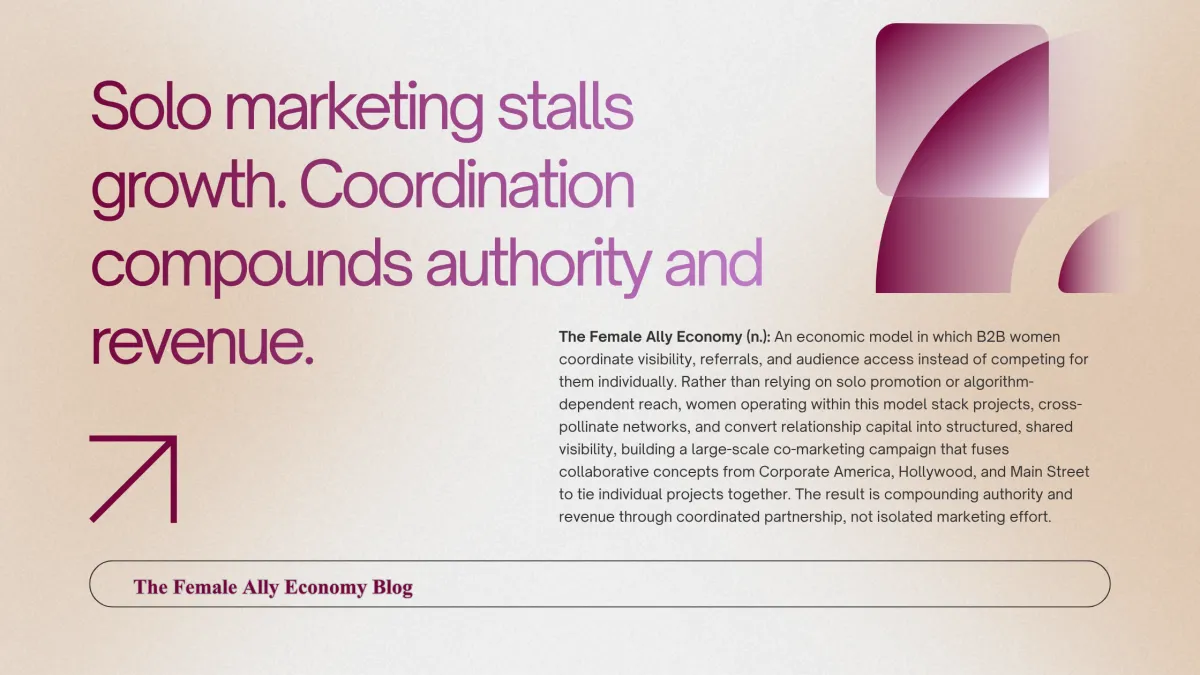
For women running B2B coaching and consulting practices, tentpole marketing is especially powerful because it leverages what you already do well: relationship‑building and community. The key is to move from informal support (“I’ll share your post!”) to intentional co‑marketing with structure.
Define your tentpole. Choose one offer to build around—ideally high‑ticket or high‑leverage. Set a clear launch window and a compelling theme your partners can stand behind.
Identify complementary brands. Look for women‑led businesses that serve the same decision‑makers but solve different problems: operations, finance, HR, sales, branding, or tech implementation.
Design a shared campaign. Map specific assets—joint workshops, panel discussions, resource bundles, podcast episodes, or LinkedIn Live series—scheduled to build momentum into your launch week.
Make it easy to promote. Provide swipe copy, graphics, talking points, and clear links so partners can plug into the campaign with minimal friction.
💡 Pro Tip: Treat partners like co‑producers, not affiliates. Ask what outcomes they want—leads, visibility, content—and design win‑wins into the campaign.
Why Clustering Complementary Brands Multiplies Reach, Authority, and Revenue
When you cluster complementary brands around one initiative, you’re not just “getting in front of more people.” You’re changing how your market perceives you and how quickly they decide to buy.
Reach: Each partner brings their own email list, social following, and client base. Because everyone promotes in the same window, your message shows up repeatedly across multiple trusted channels.
Authority: Being featured alongside respected peers positions you as part of the “go‑to circle” for your niche. Decision‑makers see you as a leader inside an ecosystem, not a lone voice.
Revenue: Concentrated attention shortens sales cycles. Prospects encounter your offer multiple times, from multiple angles, with multiple endorsements—reducing risk and accelerating “yes” decisions.
Hollywood understands this math instinctively: one movie, many partners, one massive moment. As a B2B woman, you can use the same tentpole logic to turn your next launch into a blockbuster—without needing a studio budget.
Your Next Step: Choose Your Tentpole
Don’t start with “Who can promote me?” Start with “What single moment is worth building a tent around?” Once your tentpole is clear, the right partners, assets, and opportunities become easier to spot—and your launch stops relying on hope and hustle alone.
Don't Build the Tentpole Alone
Hollywood doesn't produce a blockbuster by announcing a release date and hoping people show up.
It builds the crew, partnerships, promotional assets, and distribution strategy around the tentpole long before opening day.
Your launch deserves the same level of intentionality.
The Badass Boardroom is where you can turn that strategy into a collaborative campaign.
Instead of asking:
"Who can I get to promote my launch?"
we work from a better question:
"Who can help me build the campaign?"
Inside the Boardroom, you'll learn how to identify women in your network with complementary:
Expertise
Audiences
Relationships
Offers
Visibility
Distribution channels
Then bring those women around a central launch moment and give each person a meaningful role in the campaign.
Your tentpole might be a:
Cohort. Summit. Membership. Podcast. Anthology. Signature offer. Retreat.
The format can change.
The strategy doesn't.
One central moment. Multiple aligned partners. Coordinated promotion. Shared momentum.
That is how you stop treating your launch like a solo performance and start treating it like a co-produced event.
The Badass Boardroom gives you the environment to build the micro-tribe that can make that possible.
Don't wait until launch week to look for your cast.
Build the crew first.
Bring your next tentpole. We'll help you identify the women, relationships, and collaborative opportunities that can turn one launch moment into a much larger market event.
Your tentpole is the moment. Your tribe is the amplification engine.