Why Exceptional Women Still Struggle to Grow Their Businesses
Some Businesses Need Structure, Not More Hustle
There is a moment many accomplished women reach where effort stops producing proportional results. More content does not produce more clients. More networking does not produce more collaborators. More hours do not produce more revenue.
At that moment, the standard advice is to push harder. The more accurate diagnosis is that the business has hit a structural ceiling that additional effort alone cannot raise. What is missing is not motivation. It is architecture.
What Collaborative Architecture Actually Means
Collaborative architecture is the deliberate design of relationships, roles, and shared projects that allow multiple women's businesses to grow together rather than independently.
It is not a mindset. It is not a philosophy about community. It is structure—built with the same intentionality a company applies to an org chart, a distribution system, or a supply chain.
Where solo effort depends on one woman's time, network, and energy, collaborative architecture distributes those functions across a tribe. Visibility is shared. Audiences are cross-pollinated. Responsibility for outcomes is assigned by role rather than absorbed entirely by one person.
The architecture does the work individual effort was never designed to do alone.
This distinction matters because most business advice conflates activity with structure. Posting daily is activity. Attending networking events is activity. Neither, on its own, is architecture. And activity without architecture eventually produces exhaustion rather than expansion.
Why Effort Alone Cannot Substitute for Structure
Consider two women running comparable businesses.
One works longer hours, posts more frequently, and personally manages every aspect of her visibility and outreach.
The other has built relationships with four aligned women, each contributing a distinct role: one handles amplification, one handles introductions, one co-creates assets, and one manages audience cross-pollination.
The first woman’s output is capped by individual capacity. No matter how disciplined she becomes, she cannot exceed the limits of one person’s time and one person’s network.
The second woman’s output is not capped in the same way, because her business is no longer operating on individual capacity alone. It is operating on the combined capacity of a structure.
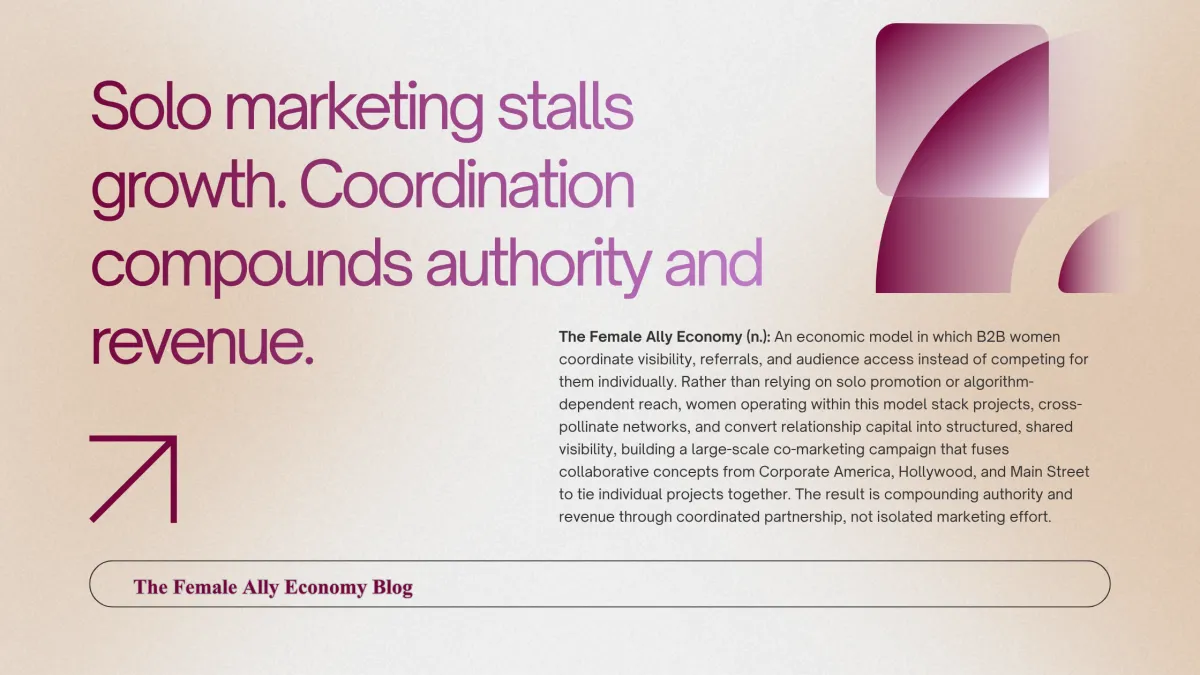
This is the core argument against solo marketing as a long-term growth model. It is not that solo effort fails. It is that it has a built-in ceiling, while collaborative architecture does not.
Why This Matters More for Seasoned Women Specifically
Accomplished B2B women over 50 are often sitting on more raw material for collaborative architecture than they realize: decades of relationships, established credibility, and a body of work that already carries authority inside their industries.
What is typically missing is not the material. It is the structure that organizes that material into something repeatable.
Without architecture, every new project starts from zero. A summit gets built, promoted, and completed, and the next launch begins the same climb with none of the previous momentum carried forward.
With architecture, each project strengthens the next. The tribe compounds. Audience access compounds. Credibility compounds.
This compounding effect is the defining advantage of collaborative architecture over individual tactics. Tactics produce isolated outcomes. Architecture produces outcomes and builds capacity for the next one simultaneously.
What Repeatable Growth Actually Requires
Repeatable growth requires four elements that individual effort cannot generate alone:
An anchor project that gives the tribe a shared reason to organize.
Defined roles that distribute responsibility according to each woman’s Business DNA rather than available bandwidth.
A mechanism for cross-pollinating audiences so visibility compounds across the tribe instead of remaining siloed.
And a structure durable enough to outlast any single launch, so relationships remain active beyond one campaign.
None of these emerge from goodwill or informal collaboration alone. They require design—which is what separates architecture from networking or casual partnership.
What This Means for You
If your business has hit a ceiling that more effort has not moved, the problem was never your work ethic.
The problem is that solo effort was never designed to scale indefinitely, regardless of how talented or disciplined the woman applying it happens to be.
What raises that ceiling is not another tactic. It is architecture: a structure that distributes visibility, shares audiences, and compounds momentum across a tribe instead of concentrating it inside one person’s limited capacity.
This is precisely what the Badass Boardroom was built to construct.
Not another course on marketing tactics, but a working environment where collaborative architecture is built in real time—role by role, project by project, starting with two trusted allies.
Some businesses do not need more effort poured into the same solo model.
They need the structure that effort alone was never going to build.
The Badass Boardroom is where that structure gets built.