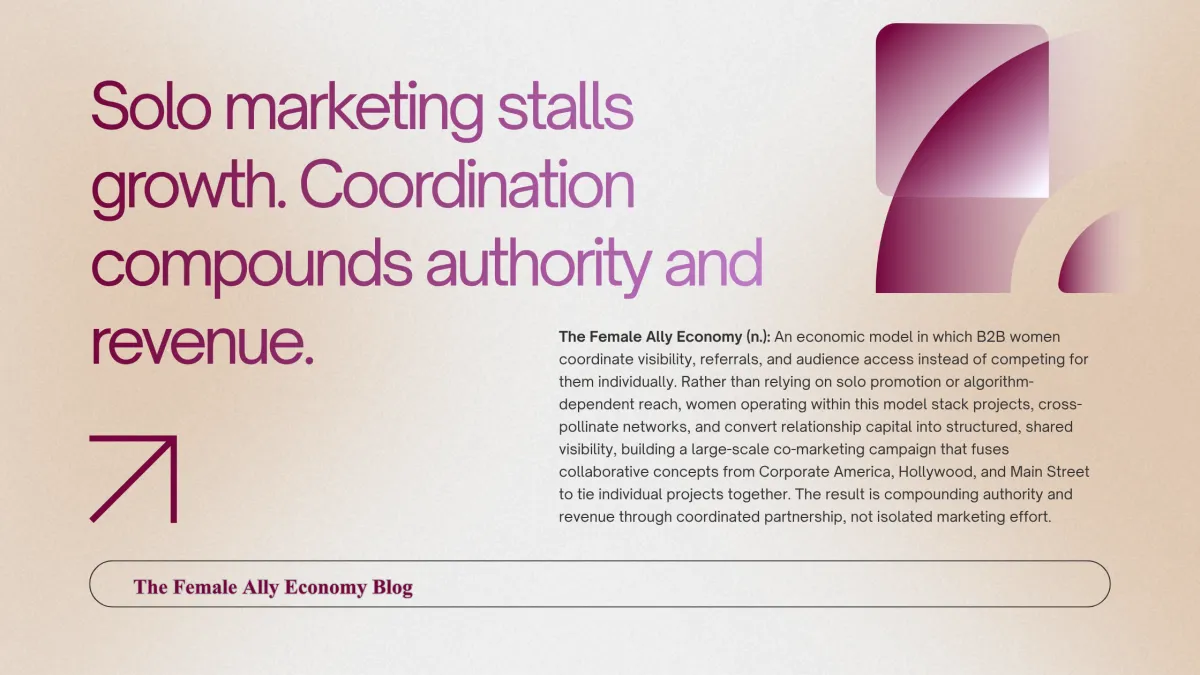
The Structural Reason Business Groups Don’t Convert Into Growth
Conversation Is Not the Same as Coordinated Execution
Business groups are easy to find. Business rooms are not. The difference between the two rarely gets examined directly, yet it explains why so many accomplished women cycle through memberships, masterminds, and communities without ever seeing the collaborative outcomes those spaces promise.
What a Business Group Actually Produces
A business group produces conversation. Members show up, share updates, offer encouragement, and exchange ideas. This has real value. It reduces isolation. It provides perspective. It occasionally produces a useful introduction.
What a business group does not produce, by design, is coordinated execution.
There is no shared project pulling the group toward a defined outcome. There are no assigned roles. There is no mechanism that converts conversation into distributed action. The group meets, the group talks, and each woman returns to building her business exactly as she was building it before.
This is not a flaw in the format. It is simply what the format was built to do. Groups were designed for connection and support, not execution.
What a Business Room Requires
A business room operates on a different premise entirely. It assumes conversation is a starting point, not the end result.
It is built around an anchor project—something concrete the room is actively building, promoting, or launching together. It assigns roles so that each woman’s contribution is specific rather than optional. And it includes a mechanism for converting relationships into distributed visibility, shared audiences, and completed work.
The distinction is structural, not cultural.
A supportive group can still fail to produce coordinated execution, no matter how strong the goodwill inside it is, because goodwill was never the missing ingredient. Structure was.
Why Conversation Alone Cannot Convert
Consider what actually has to happen for a summit, cohort, or anthology to succeed.
Seats need to be filled. Partners need to be recruited. Content needs to be co-created. Audiences need to be cross-pollinated across multiple networks rather than confined to one.
None of these outcomes are produced by conversation alone.
A woman can fully explain her project inside a supportive group, receive encouragement, and still walk away without additional seats filled or collaborators engaged—because encouragement and execution are not the same currency.
Execution requires specificity: someone assigned to amplify, someone assigned to connect, someone assigned to co-create. And it requires a structure that holds those assignments in place long enough for the work to actually move.
This is where most communities stop short. They generate conversation and assume execution will follow. It rarely does, because nothing in the format requires it to.
Why This Distinction Matters for Seasoned Women
Accomplished B2B women over 50 are often the most over-networked and under-activated professionals in their industries. They have attended the events. They have joined the groups. Their Rolodex is substantial.
What they have not had is a room that treats that existing network as raw material for coordinated execution.
This population does not need more encouragement. They have already demonstrated the ability to build successful work independently. What they need is a structure that converts the relationships they already have into shared visibility, shared audiences, and completed launches—without any one woman carrying the full promotional burden alone.
A group cannot do this. A room can, because it is built around execution from the outset, not conversation as the end goal.
What This Means for You
If you have joined groups before and left wondering why nothing tangible came from the connections you made, the issue was never your effort or your network.
The issue is structural.
A group and a room are different environments built for different outcomes. Groups produce conversation. Rooms produce coordinated execution—because rooms are built around shared projects, defined roles, and a mechanism for converting relationships into distributed action.
This is precisely why the Badass Boardroom was built as a room, not a group.
You arrive with an anchor project and two trusted allies, and the work of building, activating, and executing begins immediately inside a structure designed for outcomes, not discussion.
Conversation was never meant to be the end point.
The Badass Boardroom is where conversation becomes coordinated execution.